Don’t miss a post. Click here to sign up for our free newsletter.
Not Stiff, Not Limp: Discovering the Spring Inside Your Tai Chi
Pick up a playground ball sometime, the big rubbery kind kids kick around at recess, and press your palm slowly into it. The ball gives a little. It doesn’t fight you, and it doesn’t collapse either. Press harder, and it gives a bit more, but it also pushes back a bit more, always matching you. The moment you ease off, it springs right back into its round, full shape as if nothing had happened. Push a beach ball under the water, and it does the same thing, sliding sideways and bobbing back up, completely unbothered.
That simple, almost childish experience holds one of the most important qualities we work on in Tai Chi. It sits right between two habits most of us carry around all day without noticing. On one side is bracing: shoulders up, jaw tight, arms stiff, the whole body hardening at the first sign of pressure. On the other side is collapsing: the body has been told to relax and simply gives up, sagging like a deflated air mattress. Neither one is strong, and neither one is free. What we’re looking for lives in between, and it feels a lot like that ball. It gives a little, and it comes back.
In a recent post, I wrote about Song, the Tai Chi idea of relaxing without collapsing. Today I want to pair it with its natural partner, Peng, because together they create the spring-like quality that makes Tai Chi feel alive. Once you sense it, it changes how you stand, how you move, and how you meet the pushes and pulls of everyday life.
Two Words, One Quality
Song (鬆) is an everyday Chinese word that means loose or loosened. In Tai Chi, it has a very particular flavor. It isn’t the looseness of someone dozing on the couch. It’s the looseness of a body that has noticed what it’s holding unnecessarily and let it go, while keeping exactly the structure the moment requires. Yang Chengfu, whose Ten Essentials remain the backbone of Yang-style practice, put this near the top of his list. His third essential is song yao, relax the waist, and his sixth is to use intention rather than muscular force. Those two lines say a great deal about where Tai Chi power comes from, and where it doesn’t.
Peng (掤) is usually translated as Ward Off, and it’s the first of the eight energies named in the Tai Chi classics. If you’ve been in one of our Long Form classes, you know it as the movement that opens Grasp the Sparrow’s Tail. But Peng is much more than one posture. Many teachers describe it as a quality that should be present in every movement of the form: a gentle, rounded fullness that fills the body from the inside, like air filling a playground ball. It isn’t pushing outward with effort. It’s simply being full.
Here’s the key: Song without Peng turns limp. Peng without Song turns stiff. Put them together, and you get a body that is soft and yielding on the surface and quietly, reliably full underneath. That combination is what gives Tai Chi its spring.
What the Old Masters Said
A short traditional verse, part of a group often called the Songs of the Eight Postures, asks the question directly: what is Peng? Its answer is a picture rather than a definition. Peng, it says, is like the water that carries a moving boat. The verse goes on to describe the whole body as filled with a springy energy, so that even a very heavy force can be lifted and floated away. I love that image, because water is the perfect teacher here. It yields to anything that pushes into it, yet it holds up a boat weighing many tons. It never gets stiff, and it never stops supporting.
Another classic, the Mental Elucidation of the Thirteen Postures, traditionally attributed to Wu Yuxiang, gives us the image I return to whenever I think about spring-like energy. It tells us to store energy as if drawing a bow and to release it as if loosing an arrow. The same text makes a claim that sounds like a riddle the first time you hear it: only through great softness can one arrive at great strength. After many years of practice, it no longer sounds like a riddle to me. It sounds like plain physics.
Then there’s the saying you’ll hear from teacher after teacher, that the arm of a skilled practitioner feels like iron wrapped in cotton. You’ll sometimes hear it as steel wrapped in silk, but cotton is the most common version. It’s a traditional saying passed along by generations of teachers rather than a line from the core classical treatises, but it captures the feeling beautifully. Soft on the outside, so a partner can’t find anything hard to push against. Full and structured on the inside, so there’s nothing to collapse either. In a well-known photograph, Professor Cheng Man-ch’ing stands calmly while four people press against his extended arm, and the arm doesn’t fold. That’s the iron in the cotton. It isn’t muscle. It’s structure filled from within.
Storing and Releasing: A Lesson in Yin and Yang
Let’s go back to that bow for a moment. When you draw a bow, you aren’t creating energy out of nowhere. You’re storing it. The bow bends, the string pulls taut, and the energy sits there waiting — what a physicist would call potential energy. The moment you let go, that stored energy turns into motion, kinetic energy, and the arrow flies. The bow springs back to its resting shape, ready to be drawn again. A spring works the same way, and so does that playground ball. Press into it, and you store energy in its rubbery walls. Let go, and that energy returns as movement. Nothing is forced. One state simply flows into the other.
This is Yin and Yang in their most practical form. Storing is Yin: receiving, gathering, sinking, drawing in. Releasing is Yang: expanding, extending, sending out. Neither is better than the other, and neither lasts forever. Each carries the seed of the other, like the small dot of light in the dark half of the Taiji symbol and the small dot of dark in the light half. The moment a bow is fully drawn, it’s ready to release. The moment the arrow flies, the bow is already returning to rest.
When I watch a good Tai Chi form, this is what I see. Weight sinks into the back leg, and the body gathers, storing. Weight flows forward, and the body opens and releases. Then it gathers again. It’s the rhythm of breathing in and out, of the tide coming and going. This never-stopping exchange of energies isn’t a philosophy we bolt onto the movements. It is the movements, the cycle of life playing out in your own arms and legs every time you practice.
And here’s the part that matters most: you can’t store energy in something rigid, and you can’t store energy in something limp. Try drawing a bow made of solid steel. It won’t bend. Try drawing a bow made of wet noodles. It won’t hold anything. A spring works only because it can give and come back. That’s exactly why Song and Peng have to work together.
Testing It With a Partner
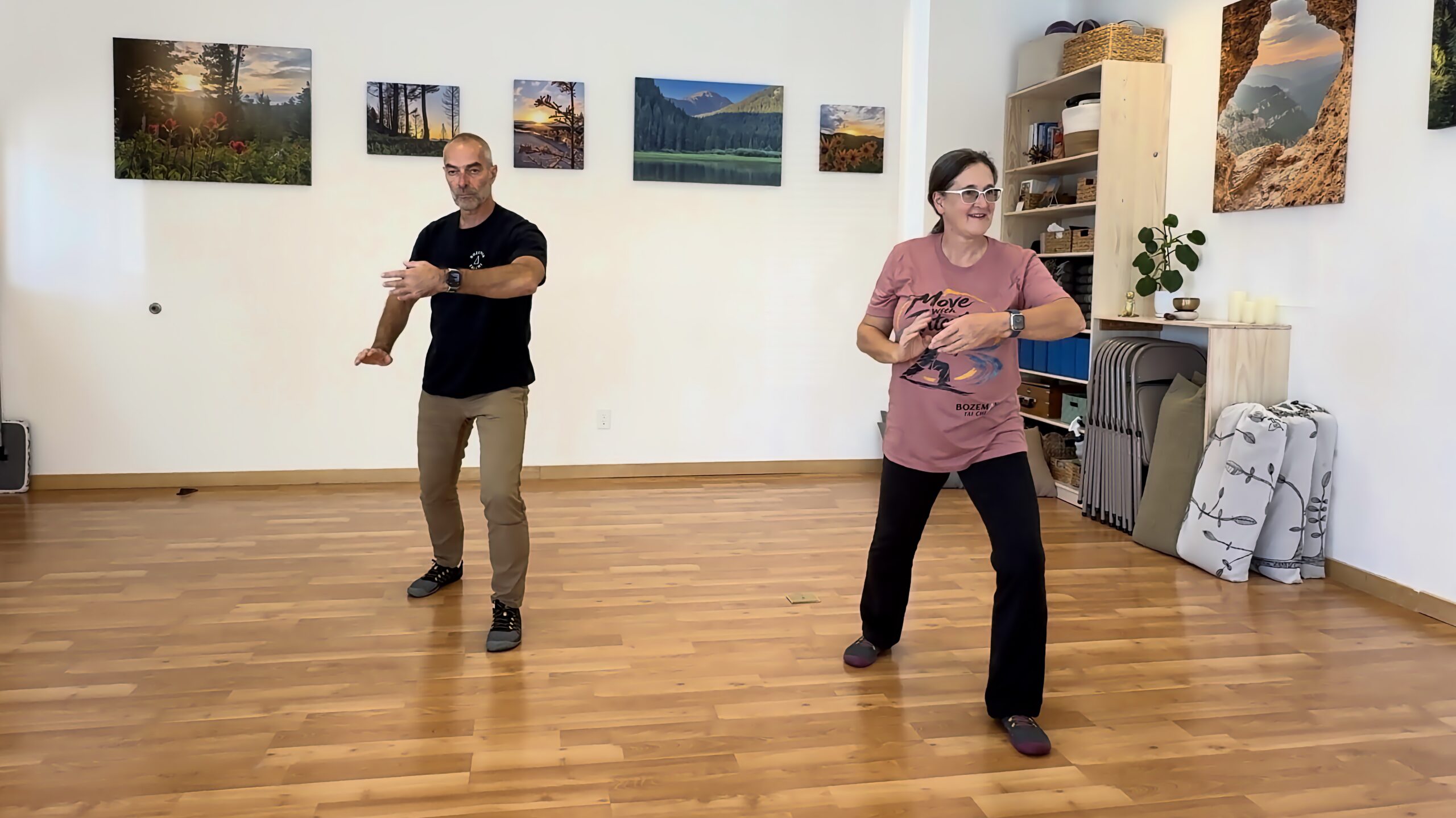
One of the most revealing things we do in class looks almost too simple to bother with. You stand in Ward Off, and a partner places a hand on your forearm and pushes gently and steadily. That’s all, yet it tells you more about your Tai Chi than almost anything else.
Usually one of three things happens. The most common response is that the arm stiffens. Your shoulders creep up, your elbow locks, your breath stops, and your upper body hardens like a fence post. It feels strong from the inside. From your partner’s side, it feels like pushing on a stick, and a stick is wonderfully easy to tip over. A little more pressure and your heels lift, because all that tension has disconnected your arm from your feet. The second response is the opposite. The arm simply gives up and folds back into the chest, and your partner’s hand ends up pressing against your ribs. You’ve yielded, but all the way to the point where there’s nothing left to come back with.
The third response is the one we’re working toward, and it feels completely different on both sides. Your partner pushes, and your arm gives a little, just like the ball. The pressure doesn’t stop in your shoulder. It travels through a relaxed elbow and an open shoulder, through a loose waist and the hip crease we call the kua, down into the foot rooted in the floor. Your partner feels something soft at first, then something surprisingly solid behind it. You haven’t lost anything. Your structure is intact, your center is calm, and the energy of their push has been received rather than resisted. When they ease off, or when an opening presents itself, your arm comes back, full and round, with no effort at all. That’s yielding with control. That’s the spring.
So the next time someone presses on your Ward Off, ask yourself a few honest questions. Am I getting stiff? Am I engaging my shoulders? Did I stop breathing? Or am I flexible yet keeping my shape, giving way just enough, and coming back when the moment is right? You don’t need to answer perfectly. Noticing is where it starts.
Three Passes Through the Form
You won’t always have a partner, so here is one of my favorite ways to cultivate this quality on your own. It works with whatever form you know: the Long Form, the Form of 24, or even a few rounds of Grasp the Sparrow’s Tail. Do your form three times in a row, each time with a different focus. The order matters, and I’ll explain why.
On the first pass, focus only on loosening up. Let every joint open a little: ankles, knees, hips, waist, spine, shoulders, elbows, wrists, even the fingers. Imagine tiny spaces opening between the bones, as if each joint were taking a long, slow exhale. Don’t worry about precision or power. If something feels sticky or tight, just notice it and invite it to soften. This pass is about clearing out the tension you brought with you from the day.
On the second pass, sink in and get comfortable. Think about your favorite old recliner, the one that has shaped itself to you over the years. Remember dropping into it at the end of a long day, when your whole body seems to sigh and settle. Bring that feeling into your stance. Let your weight drop into your feet, your hips settle, your shoulders hang. You’re not slumping. You’re making yourself at home in the posture and letting the ground hold you up so your muscles don’t have to.
On the third pass, and this is the critical one, let expansive energy fill your movements. Regular readers will recognize the garden hose. Picture one lying limp on the lawn, holding no shape at all. Then someone turns on the tap. Water rushes in, and the hose fills, lifts, straightens, and takes on a flexible, living structure all on its own. Nobody muscles it into shape. The water does the work. Let a feeling of gentle expansion fill you the same way, from your center out to your fingertips and down through your legs into the floor, and let that feeling, not your muscles, carry the power of each movement.
Here’s the most important instruction of all: at no cost do we want to muscle it. The moment you try to force the fullness, bracing your arms or stiffening your back to feel more substantial, you’ve turned the hose back into a frozen pipe. You may look strong, but you’ve lost the spring. If you catch yourself tightening, smile, return to the feeling of the first pass for a breath or two, loosen, sink, and let the fullness come back on its own. It always does if you give it room.
Why this order? Because you can’t fill a hose that’s kinked or frozen solid. Loosening opens the channel. Sinking gives the water something to push from. Only then can the expansion move freely. Skip the first two steps, and the third almost always turns into tension wearing the costume of strength. Don’t be discouraged if the third pass feels elusive at first. With practice, the moments get longer, and the three passes begin to merge, until you find yourself loose, settled, and full all at once. That’s when your form starts to feel less like a sequence of postures and more like one long, gently pulsing breath.
The Spring Off the Practice Floor
The longer you play with this quality, the more it shows up in places that have nothing to do with Tai Chi. A coworker pushes back on your idea, and instead of stiffening up or caving in, you give a little, listen, and calmly return to your point. Someone bumps into you in a crowded store, and your body absorbs it without drama. A winter walk on icy Montana sidewalks asks your ankles and knees to adjust a dozen times, and they do, quietly, because they’ve learned that springy is safer than rigid.
That, to me, is the real gift of Song and Peng. We don’t have to choose between being tough and being gentle. We can be both at once, the way water is both, the way a good bow is both. Soft enough to receive what life sends our way. Full enough not to be knocked over by it. And always ready to spring back.
Come Feel It for Yourself
An article can only point in the right direction, like the famous finger pointing to the moon. This quality comes alive when a partner presses on your arm, and you discover that relaxing makes you more stable, not less. That kind of discovery happens in seconds in a room together. It can take years on your own.
That’s what our classes are for. At Bozeman Tai Chi, we teach traditional Yang-style Tai Chi Ch’uan and Qi Gong in a relaxed, supportive setting where questions are welcome, and laughter is common. You don’t need to be young, flexible, or athletic to start. You just need a little curiosity and a willingness to pay attention to how you move.
If you recognize your own shoulders creeping toward your ears, or you’re curious what it would feel like to stand with a little more spring and a little less strain, reach out and join us for a class. We’d love to help you find the iron in your cotton. And who knows, the next time someone pushes on your Ward Off, you might just feel yourself give a little and come right back.