Don’t miss a post. Click here to sign up for our free newsletter.
The Meaning of Energy in Tai Chi
Few words in Tai Chi create more curiosity — or more confusion — than the word energy (Chi or Qi in Chinese).
Spend time in a class, read traditional writings, or talk with longtime practitioners, and you’ll hear it constantly. We speak of feeling energy in the hands. Of rooting into the ground and letting it rise through the body. Of flow, softness, fullness, and power. Movement begins in the feet, we say, is guided by the center, and reaches into the fingertips.
For someone new to Tai Chi, this language can sound inspiring. But also: what does it actually mean?
Is it describing something physical? Is it old language for posture and body mechanics? Is it about breath and circulation? A metaphor for awareness? A real sensation people develop through training?
In my experience, in Tai Chi, energy often describes more than one related experience at once.
That can feel strange to a modern Western mind. We tend to want sharp definitions and cleanly separated categories. One word, one meaning. Traditional East Asian movement practices work differently — a single term can carry layers of meaning simultaneously, pointing to physiology, sensation, movement quality, and training intention all at the same time.
Tai Chi is that kind of art.
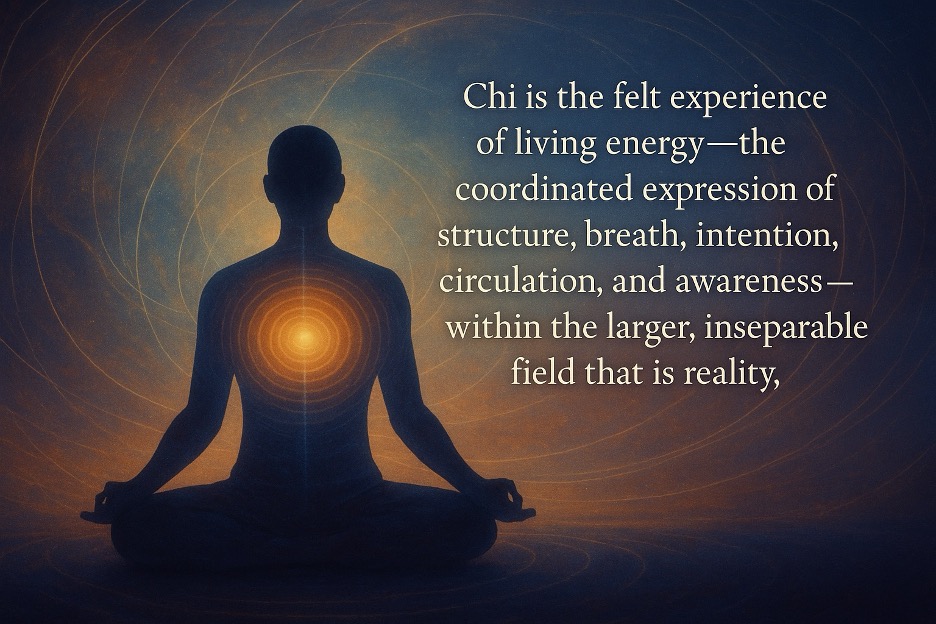
When teachers speak about energy, they’re usually pointing toward two realities happening together. One is the internal experience — the vitality, connection, and bodily awareness that develops through practice. The other is the practical mechanics of efficient movement: how force is generated, transferred, stored, and expressed through the body.
Both are real. Neither cancels the other.
The Energy You Can Feel
Most students come to Tai Chi hoping for something practical — better balance, less stress, gentle movement. Those are good reasons to start.
Then something interesting tends to happen.
After class, people commonly report feeling calmer, warmer, more settled. Some notice they’re breathing more deeply. Others notice their hands feel warm, their posture more natural, their thoughts quieter. Many simply say: “I feel better than when I walked in.“
These experiences make sense. Slow mindful movement, focused attention, and relaxed breathing can influence circulation, stress response, and body awareness in measurable ways. Tai Chi has been studied for benefits related to balance, physical function, and stress reduction.
With consistent practice, people often become more attuned to subtle sensations: weight settling through the feet, smoothness through the joints, steadiness through the torso, a warmth in the limbs, a feeling that the body is moving as one connected thing rather than a loose collection of parts.
Traditional teachers described this using the language of cultivating, gathering, sinking, or circulating energy.
Whether you prefer the classical phrasing or a modern explanation, the lived experience is what matters: the body can feel more integrated, more responsive, and more alive through steady practice.
The Energy of Movement
There’s a second meaning of energy that’s equally important — and easier to describe in plain terms.
Imagine someone trying to move a heavy object using only their arms and shoulders. The neck tightens, the shoulders strain, effort leaks in every direction. Now imagine a different person: feet planted, legs driving, hips turning, trunk transferring, arms arriving last as the final link in a connected chain.
The second person is using their body more efficiently. They’re not necessarily stronger. They’re more organized.
Tai Chi trains this principle constantly.
Rather than overusing the hands and shoulders, practitioners learn to organize movement from the ground up — stable feet, coordinated legs, turning through the hips and waist, a responsive trunk, relaxed arms. The traditional saying “movement begins in the feet, is directed by the waist, and expressed in the hands” is as much practical coaching as it is philosophy.
When classical texts describe energy rising through the legs, gathering in the center, traveling through the spine, and reaching the fingertips, they may simply be describing whole-body coordination in the language available to them.
That doesn’t require mysticism. It reflects sound principles of sequencing, leverage, timing, and force transfer.
Both Meanings Can Coexist
The common mistake is thinking we have to choose.
Some insist energy refers only to invisible forces and dismiss all talk of mechanics. Others reduce Tai Chi to calisthenics and wave off anything that sounds traditional. Both views become limiting.
Human movement doesn’t divide neatly into boxes. Breath affects posture. Attention affects coordination. Relaxation changes how strength is expressed. Anxiety shifts balance. Efficient alignment changes how effort feels.
The internal experience and the external mechanics are not separate — they shape each other.
This is why Tai Chi language tends to be layered. It developed through observation long before modern sports science had its vocabulary. Older terms often bundled together things we’d now describe separately: respiration, coordination, force, awareness, bodily sensation.
Rooting: A Useful Example
Take the concept of rooting.
At first, it sounds symbolic — almost poetic. But in practice, it refers to something quite concrete. The feet spread naturally. Weight settles more clearly. The legs support the body without locking. The hips release unnecessary tension. Balance improves. Wobbling decreases.
At the same time, many people report a subjective sense of downward settling — of becoming harder to move, not through effort but through groundedness.
So is rooting a metaphor, a mechanical principle, or a felt experience? In Tai Chi, it’s usually all three.
On Relaxation
Relaxation is another word that gets misread.
Tai Chi doesn’t aim for limpness or collapse. It aims to reduce unnecessary tension while preserving structure and responsiveness. Most of us carry chronic holding in the jaw, shoulders, chest, lower back, or hips — tension we’ve accumulated and forgotten about. That tension interferes with breathing, range of motion, and how efficiently the body can move.
When those patterns soften appropriately, movement often becomes easier and breathing freer. Experienced practitioners can appear almost still while moving with surprising control — not because they’re weak, but because they’ve learned economy.
Relaxation, in this context, is efficiency, not passivity.
The Dantien: Center of Gravity and Attention
Traditional Tai Chi places great importance on the dantien — the lower abdominal center, roughly two inches below the navel.
In modern terms, this region is near the body’s center of mass, associated with diaphragmatic breathing and trunk organization. When students learn to initiate movement from here rather than from the hands or arms, they often notice smoother stepping, better turning, steadier balance.
So is the dantien symbolic, functional, or experiential? As with rooting, the answer depends on what you’re working on — and often, it’s all three.
Nature Rarely Chooses One Side
Tai Chi was shaped by observing natural patterns. Water yields but reshapes stone. Trees are rooted but flexible. Animals appear relaxed until they aren’t.
The body works the same way. Stability and mobility need each other. Strength depends on timing and coordination, not muscular force alone. Calm attention tends to improve performance.
When Tai Chi speaks of energy, it may be describing not one isolated thing, but the meeting point of many connected processes.
Come Experience It
For Beginners
If you’re new to Tai Chi, you don’t need to chase unusual sensations or adopt beliefs that don’t yet feel true to you.
Start with the fundamentals. Stand comfortably upright. Let the shoulders soften. Feel your feet on the floor. Breathe naturally. Shift weight smoothly. Turn from the torso. Move slowly enough to notice what you’re doing.
These simple skills are the foundation. Everything else builds from here.
As consistency develops, most students naturally begin to notice improved balance, calmer breathing, better body awareness, and a growing sense of ease. Tai Chi tends to reward patience far more than intensity.
For Those Who’ve Been Practicing a While
Longtime students know that the same principles keep revealing new layers.
Sometimes movement looks right but feels tense. Sometimes relaxation is there but structure goes vague. Sometimes the breath is smooth but timing is off. Sometimes power is attempted before coordination is ready.
The art keeps refining the relationship between softness and strength, stillness and motion, effort and ease. That’s one reason Tai Chi stays interesting for decades — there’s always another layer to understand.
Join a Class
This subject can be discussed at length, but it becomes clearest through practice.
You understand rooting when your balance feels steadier. You understand relaxation when your shoulders stop doing work they never needed to do. You understand whole-body movement when a simple action feels smoother and stronger with less strain.
You understand energy when you leave class feeling calmer, clearer, and more connected than when you arrived.
That’s why in-person practice matters. Guidance, feedback, repetition, and community bring these principles to life in ways that words can’t fully reach.
You don’t need prior experience. You don’t need flexibility. You don’t need to take every classical phrase literally.
You just need curiosity and a willingness to learn.
If you’ve ever wondered whether Tai Chi could help you move better, feel better, and find a quieter sense of steadiness in your body and mind — we’d love to welcome you.
Reach out, ask questions, come to a class. Sometimes the meaning of energy isn’t found in definitions at all. Sometimes it’s found in the quiet moment when your feet settle, your breath deepens, and your whole body begins to move as one.
2 Comments
I love reading your wisdom, thank you for sharing
Thank you for your kind words, Libby. It’s always a pleasure to have you in class!