Don’t miss a post. Click here to sign up for our free newsletter.
Move with Intention: Stop Steering Every Muscle and Let Your Tai Chi Come Alive
There is a moment that comes to almost every Tai Chi student, usually somewhere between the first year and the fifth. The sequence is learned. The feet land roughly where they should, the hands travel roughly where they should, and the form, if you squint a little, looks like Tai Chi. And yet something feels stuck. The movements are correct but heavy, careful but not quite alive. You finish a round and realize you spent the whole time checking yourself: Is my weight right? Is the elbow too high? Did I turn far enough? Where does the left hand go next?
If that sounds familiar, you are in very good company, and you are exactly where you need to be. This is the point where the practice asks us to shift our focus. Instead of obsessing over shapes and exact choreography, we begin to place our mind on intention: setting and visualizing the goal of a movement rather than managing its mechanical execution. It is one of the most important transitions in the whole art, and also one of the most freeing.
Getting Out of the Way
We have talked many times in class about a simple but surprising truth: mastering Tai Chi is less about learning new tricks and more about getting out of the way. Our body already has a natural way of organizing itself, of finding structure, of moving fluidly. Much of our training is the patient work of removing what interferes with that: the extra tension in the shoulders, the habit of leading with the arms, the anxious little corrections that make a movement stiff.
Moving from choreography to intention is exactly this kind of getting out of the way. It is not an advanced technique layered on top of the form. It is a way of letting the form happen.
Think about how much your body already knows. Since the day you were born, a part of you that works mostly below conscious awareness has been managing your movement. It learned to balance, to reach, to walk on uneven ground, and to catch a cup before it tips over. It has worked out, through countless repetitions, how to coordinate dozens of muscles and joints with precise timing to reach a goal. When your conscious mind says, “Pick up that apple,” you do not calculate the angle of your shoulder, the rotation of your forearm, or the moment your fingers should begin to close. You simply pick up the apple. The rest takes care of itself.
So here is the question I love to ask my students: why do we think we need to override all of that experience with our conscious mind the moment we start doing Tai Chi? The conscious mind is wonderful at many things, but as a movement manager, it is a beginner. It is slow, it can only hold a few details at once, and it is easily distracted. When we ask it to micromanage every joint through a flowing sequence, we get exactly what you would expect: movement that is careful, segmented, and a bit wooden.
To be fair, not every habit our body has picked up over the years is a good one. Most of us carry some tension we no longer notice, and some patterns that served a desk better than a body. That is precisely why we practice slowly, relax deliberately, and pay attention to structure. But the goal of that work is not to replace the body’s intelligence with a checklist. It is to clear away the clutter so the body’s own intelligence can shine through.
What Learning to Drive Teaches Us
Remember learning to drive a car? In the beginning, everything required conscious effort. Check the mirror. Signal. Foot off the gas, gently onto the brake. Hands at the right position on the wheel. Look over your shoulder. Every little action demanded attention, and the whole experience was exhausting. Then, gradually, something changed. The mechanics settled into the background. You stopped thinking about how hard to press the brake and simply slowed down when you needed to. Your attention was freed to focus on where you were going, on the traffic around you, even on the landscape rolling by. Driving became easier, safer, and a lot more enjoyable, not because you learned more rules, but because you trusted what you had already learned.
Tai Chi follows the same path. In the beginning, we do need to think about where the feet go and how the hands travel. That phase is necessary and valuable. But if we stay there forever, we are like a driver who still consciously narrates every pedal and mirror check after twenty years on the road. At some point, we need to let the mechanics sink in and lift our attention to the goal.
Movement researchers have a name for a closely related idea. They distinguish between focusing internally, on the body parts themselves, and focusing externally, on the effect or goal of the movement. Across many studies, people tend to move more smoothly and effectively when their attention rests on the goal rather than on their own joints. Generations of Tai Chi teachers arrived at the same insight long before anyone measured it, and they built a whole teaching language around it.
Why We Talk So Much About Visualization
This is the reason we use so many images in class. When I ask you to imagine your head gently suspended from above, or to feel your feet sinking roots into the earth, or to move as if you were wading through warm water, I am not being poetic for its own sake. Each image is an instruction, delivered in the language the body understands best. An image sets an intention, and the body organizes itself to fulfill it.
There is an old Tai Chi idea that the mind leads and the energy follows, and that the body follows the energy. Whatever your view of Qi, the practical meaning is easy to feel: when your intention is clear, the movement organizes around it. When your intention is vague or buried under a pile of technical corrections, the movement loses its direction and its life.
So let us bring this down to earth with a few examples from the movements we practice together.
Ward Off: The Beach Ball
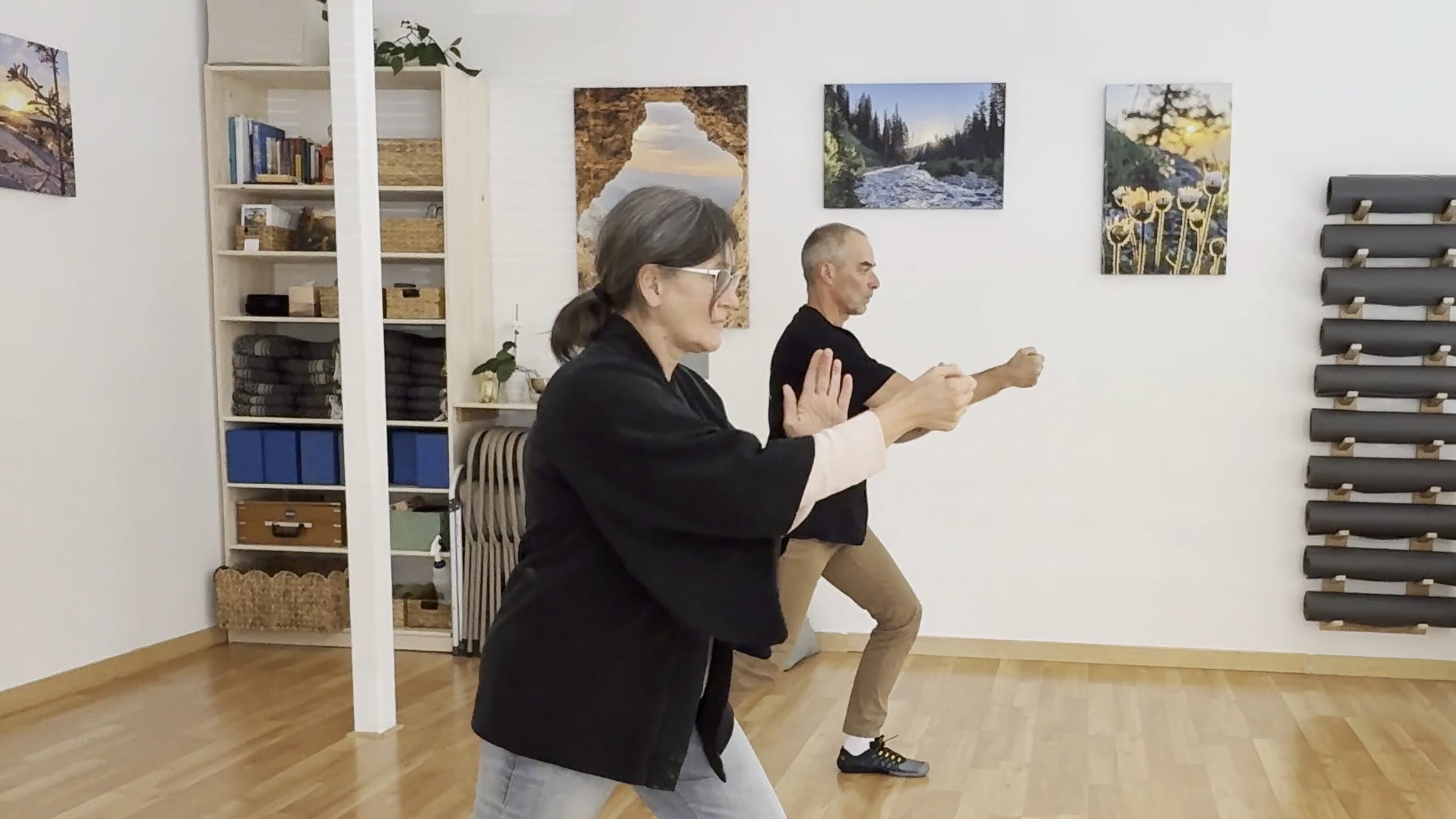
In Ward Off, the natural temptation is to think, “Push my arm out.” The arm then does most of the work on its own, the shoulder tightens, and the whole structure becomes surprisingly easy to move. Try something different. Imagine a big beach ball slowly inflating around your Dantien, the center just below your navel. As it expands, it gently fills the space in front of you and carries your arm outward on its surface. You are not pushing the arm. The arm is simply riding on the growing ball.
When you practice this with a partner, the same idea applies. Don’t try to push your partner away. Just do your thing, let the ball expand, and treat your partner as if they happen to be in the way. You will likely notice that the movement becomes rounder, fuller, and more connected, and that your partner finds you much harder to collapse than when you were straining with your arm.
Rollback: The Two-Person Saw
Rollback is where many students tense up, because the incoming force feels like something to fight. The instinct is to shove it sideways or to “break” the partner’s movement. Instead, imagine drawing in your partner’s energy as you gently guide it past you, joining its direction rather than opposing it. Their incoming force is not a threat to overcome. It is something you can connect with, a line to hold on to that actually helps you stay settled and rooted while your waist turns.
An image I love for this is the old two-person crosscut saw, the long blade with a handle at each end that loggers used long before chainsaws. Anyone who has worked with one of these learns quickly that you never push the blade. If you do, it bends and binds in the cut. Instead, each person pulls in turn, and when the blade travels toward your partner, you simply let your arms follow along, relaxed and connected, without adding force or holding back. When it is your turn, you draw the blade toward yourself, and the rhythm of the exchange makes the work flow. Two people fighting each other on that saw get nowhere and wear themselves out. Two people who listen to each other can cut through a big log with steady, surprisingly easy strokes.
Rollback has that same spirit. You receive your partner’s movement, follow it, and draw it along its path. You don’t fight it, and you don’t collapse under it. And as that exchange unfolds, it naturally sets you up for your next movement, just as each stroke of the saw sets up the next.
Push: Reaching for the Shoulders
In Push, the obvious intention is to push the partner away. That intention almost always leads to leaning, straining, and using the arms and shoulders instead of the whole body. So try forgetting about pushing altogether. Instead, simply reach out and touch your partner’s shoulders, or better yet, imagine reaching for a point a little farther out. You are not pushing your partner. You are just extending toward a spot beyond them, and they happen to be standing in the path of your movement.
This subtle shift changes everything. The legs drive, the waist directs, the hands arrive, carried by the whole body, and the movement stays relaxed. The classics describe this pathway as rooted in the feet, issued through the legs, controlled by the waist, and expressed through the fingers. Intention is what lets that pathway work without interference.
Press, and Brush Knee and Push: Reaching Beyond
The same principle deepens in Press, and it appears again in Brush Knee and Push. Rather than driving forward against your partner, imagine that there is an object sitting on a table just behind them, and you are reaching for it. Your partner is not the target. The object beyond them is. You reach through and past them instead of working against them.
It is remarkable how differently the body organizes itself with that simple image. When we try to work against something, we brace and harden. When we reach for something, we extend, lengthen, and stay alive. The first feels like a struggle. The second feels like Tai Chi.
The Energies Hidden in the Form
The examples above are four of the Tai Chi energies we have talked about before: Ward Off (Peng), Rollback (Lu), Press (Ji), and Push (An). In the classical framework of the Eight Gates, these are the four primary energies, and they are paired with four “corner” energies. One of those corner energies, Split (Lie), is a wonderful fifth one to explore next. We practice this feeling in Single Whip, where the body opens, and the energy travels in two directions at once.
It helps to think of these energies not as techniques but as movement intents. Each one is a different quality of purpose: expanding, receiving, concentrating, reaching, dividing. And every movement in the form embodies one or more of them, often several within a single posture.
Take Brush Knee and Push as an example. The forward-traveling hand carries the reaching, pressing intent we just explored. The lower hand, sweeping down and across in front of the knee, carries a Ward Off quality, gently deflecting and protecting. And when you settle back and gather yourself in preparation for the next Brush Knee, you find the receiving, drawing-in quality of Rollback. One posture, three intentions, all flowing into each other.
Here is an invitation for your practice this week. As you move through the form, try to identify the energies at work in each posture. You don’t need to be certain, and you don’t need to get it “right.” Simply ask yourself: what is the intention here? Am I expanding, receiving, reaching, or dividing? Then, little by little, let that intention replace the long list of mechanical details you have been carrying. Hold the image, set the goal, and let your body do its work.
You may be surprised by what happens. Movements you have been polishing for months may suddenly feel easier, and the form may begin to feel less like a sequence you are performing and more like something that is happening through you.
From Force to Intention
None of this means that structure and alignment stop mattering. They matter enormously, and we will keep refining them together in class. But the way we refine them changes. Instead of forcing the body into a shape from the outside, we give it a clear purpose from the inside and let the structure emerge to serve that purpose. When a correction is needed, we often find that a better image fixes it faster than a more detailed instruction.
This is the shift from force to intention, and from micromanagement to intention. It is also, quietly, a lesson that reaches far beyond the practice hall. How often in life do we try to control every detail, gripping the wheel so tightly that we can’t enjoy the drive? How often would things go more smoothly if we set a clear goal, trusted what we already know, and let go of the need to manage every step? Tai Chi gives us a safe, gentle place to practice that trust, one movement at a time.
Letting go of control can feel strange at first, and some days the old habit of checking every detail will creep back in. That is perfectly fine. Notice it, smile at it, and return to the image.
Your Reminder for Every Class
If you take away only one thing from this post, let it be this simple phrase. Bring it with you to every class, and whisper it to yourself before you begin the form:
“Move with intention! Don’t try to micromanage your movements.”
I might even make some new T-shirts for that. 😉
Come Explore This with Us
Reading about intention is a good start, but the real discovery happens when you feel it in your own body, ideally with a partner and a teacher nearby to help you notice the difference. That moment when a strained, effortful push suddenly becomes an easy reach, or when a stiff Rollback turns soft and settled, is something you have to experience to fully understand.
Whether you are brand new to Tai Chi, returning after a break, or a longtime student ready to move beyond choreography, we would love to practice with you. Our classes are welcoming, unhurried, and built around exactly these kinds of discoveries. You don’t need any special fitness level or experience, just a willingness to explore and a little curiosity about what your body already knows.
Come move with intention. Your body knows the way. Let’s give it the chance to show you.