Don’t miss a post. Click here to sign up for our free newsletter.
Most students walk into their first Tai Chi class and assume the name of what they’re learning is simply “Tai Chi.” Understandable. That’s what the flyer said, that’s what their doctor recommended, and that’s probably what their neighbor calls it. But here’s something worth knowing early on: the full name of the art we practice is Tai Chi Ch’uan — or in modern Pinyin, Taijiquan — and that small distinction opens a door to understanding everything about how and why we move the way we do.
Let’s slow down and look at those words carefully. Because once you understand what they mean, you’ll never look at the form the same way again.
Tai Chi: The Dynamic Interplay at the Heart of Everything
“Tai Chi” on its own doesn’t refer to a martial art. It refers to a philosophical concept — one of the oldest and most elegant ideas in Chinese thought. Tai Chi means something like the “Supreme Ultimate” or “Grand Ultimate” — the most common English translations — and it describes the dynamic interplay of two opposing but inseparable forces: Yin and Yang. Some scholars translate it as the “Supreme Polarity,” emphasizing that Tai Chi is less a fixed state and more the living, generative relationship between opposites from which everything arises.
You know the symbol. The circle, half dark and half light, each side containing a small dot of the other. It’s been plastered on bumper stickers and tattoos for decades, but don’t let that familiarity dull you to what it’s actually expressing. The Yin-Yang symbol — called the Taijitu — is a diagram of how the universe moves. It’s not a static image of two halves peacefully sitting side by side. It’s a picture of constant, flowing, dynamic interchange. Light becomes dark becomes light. Full becomes empty becomes full. One thing cannot exist without the other, and neither stays still.
That’s Tai Chi. Not a martial art. Not a set of slow movements in the park. A cosmological principle describing the ceaseless dance between opposites that underlies everything from the seasons to the tides to the human body in motion.
Now add “Ch’uan.”
Ch’uan: Bringing the Philosophy Into Your Body
Ch’uan means boxing or fist — a practical term referring to a martial art system. So Tai Chi Ch’uan is literally “Supreme Ultimate Boxing” or “the boxing of the great interplay.” It is the physical practice — the art form — through which the principles of Yin and Yang are embodied, trained, and expressed.
This distinction matters because it tells you exactly what Tai Chi Ch’uan is trying to do. It’s not merely a relaxation exercise that happens to look philosophical. It is a structured practice designed to train you to become the Taijitu — to move according to the same principles that govern the flow of water, the rhythm of breathing, the alternation of night and day. The form, the movements, the spiraling transitions, the weight shifts — all of it is a physical language for expressing and training the interplay of Yin and Yang within your own body.
Once you understand that, even the simplest movement in the form becomes meaningful. You’re not just moving your arms through the air. You’re practicing the Supreme Ultimate.
The Form as a Journey Between States
Here’s where it gets genuinely interesting, and where I want you to think about what we actually do every time we practice.
When we begin the form, we stand still. Feet shoulder-width apart, arms hanging naturally, weight balanced and centered. We breathe. We settle. In that moment of stillness before the first movement, Yin and Yang are in perfect equilibrium — harmonized, undifferentiated, at rest within each other. That opening stillness is, quite literally, Tai Chi. The great interplay, held in balance.
Then we begin to move.
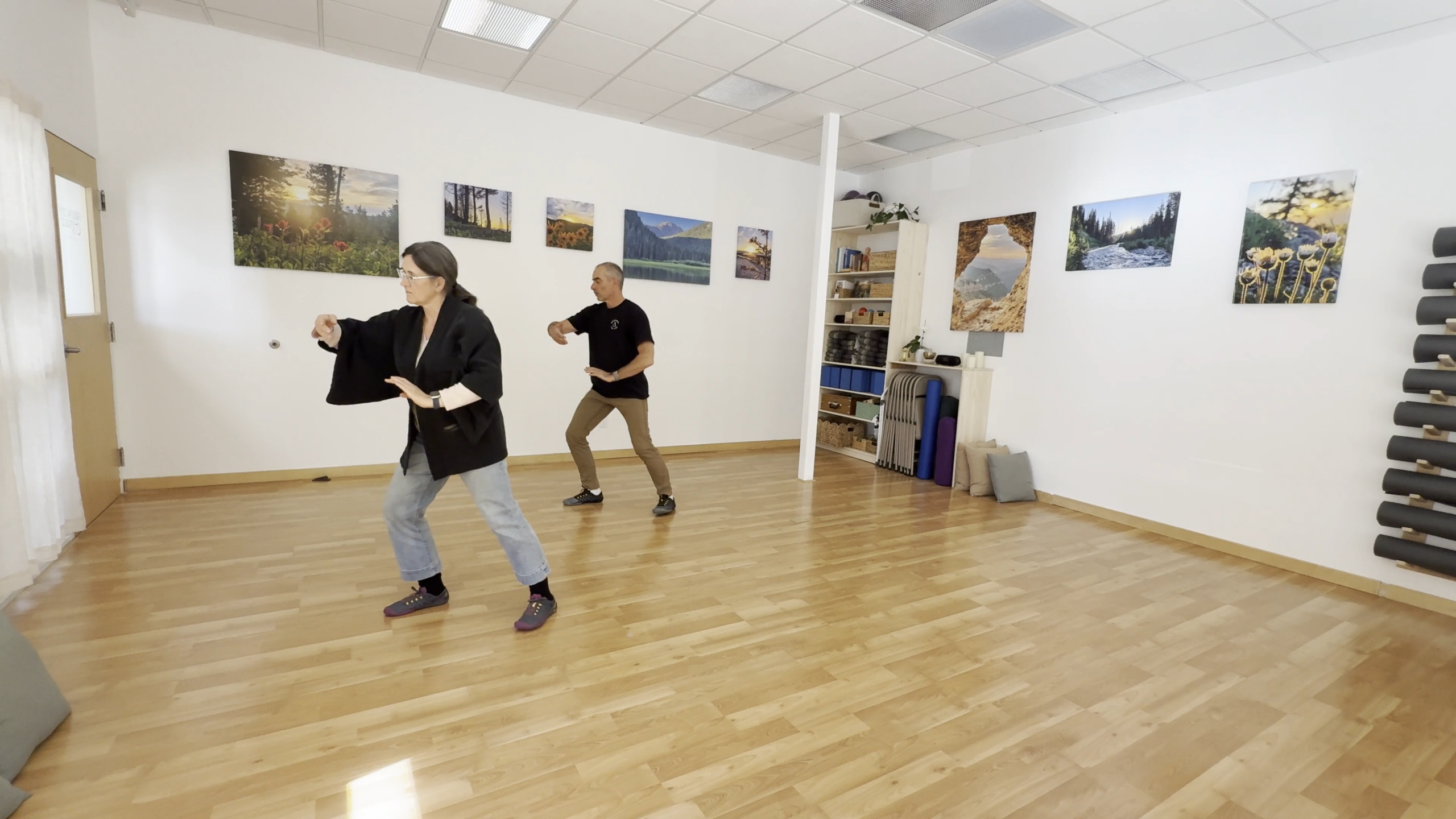
As the form unfolds — as we shift our weight, extend and withdraw, open and close, advance and yield — we are separating Yin and Yang, drawing them into contrast so that we can feel them, train them, and learn to flow between them. Every time our weight shifts forward, that leg becomes Yang — full, active, bearing load. The other becomes Yin — empty, receptive, light. Every time we extend outward in an attack posture, that movement is Yang. Every yielding withdrawal is Yin. We move through the entire form like a musician moving through a symphony, never resting on one note, always in motion between states.
And then we close. The final movements of the form bring us back to stillness. We lower our hands, settle our weight, find our center again. Yin and Yang return to equilibrium. We end exactly where we began — standing, balanced, at rest — having traveled through the full spectrum of the great interplay and come home again.
The form, seen this way, is one complete breath: inhale and exhale, separation and reunion, motion and stillness. It begins and ends in Tai Chi. Everything in between is Tai Chi Ch’uan.
Move Like a Wave
In class, I often return to the image of standing in the ocean. Not because it’s poetic — though it is — but because it’s the most accurate physical description of what Tai Chi movement actually feels like and should feel like.
Think about what a wave does. It doesn’t start and stop. It doesn’t reach a position and holds there, waiting for permission to continue. It is motion — continuous, unbroken, cycling from crest to trough and back again. The wave doesn’t hesitate at its peak or freeze at its lowest point. It moves through both, and the movement is the point.
That’s what we’re training. Not positions. Flow.
This is one of the most common misunderstandings beginners bring into the practice. We tend to think of learning a martial art as learning a series of postures — Ward Off, Rollback, Press, Push — and connecting them with transitions. But in Tai Chi Ch’uan, the postures are not the goal. The flow between them is. The posture names are just convenient landmarks for teaching and communication. They are like the names of cities on a road trip. You’re not there to sit in the parking lot. You’re there to drive.
When we truly internalize the wave principle, something shifts in how we practice. The joints stay supple — never locked, never braced. The weight shifts are smooth and continuous, not choppy or segmented. Each movement carries within it the seed of the next, the way the ocean is already gathering the next wave while the current one is still rolling to shore.
This is also where the Yin-Yang principle becomes viscerally real. Every Yang moment — every moment of fullness, extension, or expression — already contains within it the beginning of the next Yin. The extended arm is already beginning to yield before it completes its reach. The forward weight shift is already sensing its return before it lands. This is not hesitation or timidity. It’s the trained sensitivity of someone who has learned to feel the whole cycle, not just the peak of it.
Yin is pregnant with Yang. Yang is already becoming Yin. And neither ever stops moving.
The Martial Dimension
It’s worth pausing here for those of you who are curious about the martial roots of what we practice. Tai Chi Ch’uan as a combat art is built entirely on this principle of flowing between Yin and Yang — between yielding and attacking, emptiness and fullness, receiving and issuing force.
Classical Tai Chi fighting strategy doesn’t meet force with force. It yields to force — becoming Yin when the opponent is Yang — and in that yielding, redirects the incoming energy, finds the opening, and issues its own expression precisely when the opponent is empty. This isn’t passivity. It’s a sophisticated, dynamic reading of the shifting balance between Yin and Yang states in real time, and the ability to flow between them faster and more fluidly than your opponent can.
You’re not trying to be strong. You’re trying to never stop moving.
Even if you have zero interest in martial applications — and many of our students don’t, and that’s completely fine — understanding the martial logic helps you understand why the form is structured the way it is. Why we practice continuous flow. Why we avoid locking the joints. Why we train weight shifts so carefully. The form is a training method for a set of physical and perceptual skills, and knowing what those skills are sharpens your practice, whatever your personal goals may be.
What This Means for Your Practice
So what do you actually do with all of this?
Next time you practice, I’d invite you to try something. Before your first movement, stand for a moment and feel what it’s like to be in balance — weight even, breath easy, no particular focus on forward or back, left or right. Sense that equilibrium. That’s your starting point. That’s Tai Chi.
Then, as you begin to move, notice the moment the weight starts to shift. Feel one leg becoming fuller, more active, while the other softens and lightens. That’s the beginning of the separation of Yin and Yang. Follow that thread through the form. Don’t rush from posture to posture. Stay with the flow between them. Feel every transition as its own thing, not just the gap between the good parts.
And when you lose the thread — when you freeze up, when your joints go stiff, when you find yourself “arriving” at a posture and stopping — don’t be discouraged. That’s information. That’s the practice telling you where to look. The wave crashed and stopped. Let it gather again. Begin the flow again. Start small if you need to, and let the movement slowly become continuous.
This is a practice that rewards patience and deep attention. It doesn’t reveal everything at once. But every class, every session, every slow mindful repetition adds another layer of understanding. The principles are simple. The embodiment is a lifetime of work — and that’s not discouraging. That’s what makes it endlessly interesting.
Come Join Us
Whether you’re brand new to Tai Chi Ch’uan or you’ve been moving through the form for years, the wave is always there waiting for you. The principles of Yin and Yang don’t expire. They get richer the longer you work with them.
If you’ve been curious about joining a class — if you’ve been reading along and thinking “I’d like to actually feel that” — I’d genuinely encourage you to come in and try. Our classes are designed to be welcoming to beginners while offering real depth for more experienced students. You don’t need prior experience. You don’t need to be flexible or athletic. You need curiosity and a willingness to slow down and pay attention. That’s it.