
Don’t miss a post. Click here to sign up for our free newsletter.
Unfold Inner Peace with the Gentle Art of Ikebana
There’s a quiet moment that happens when you’re standing in front of a vase, a few stems in hand, and a blank space waiting to be filled.
You pause. You breathe. You look.
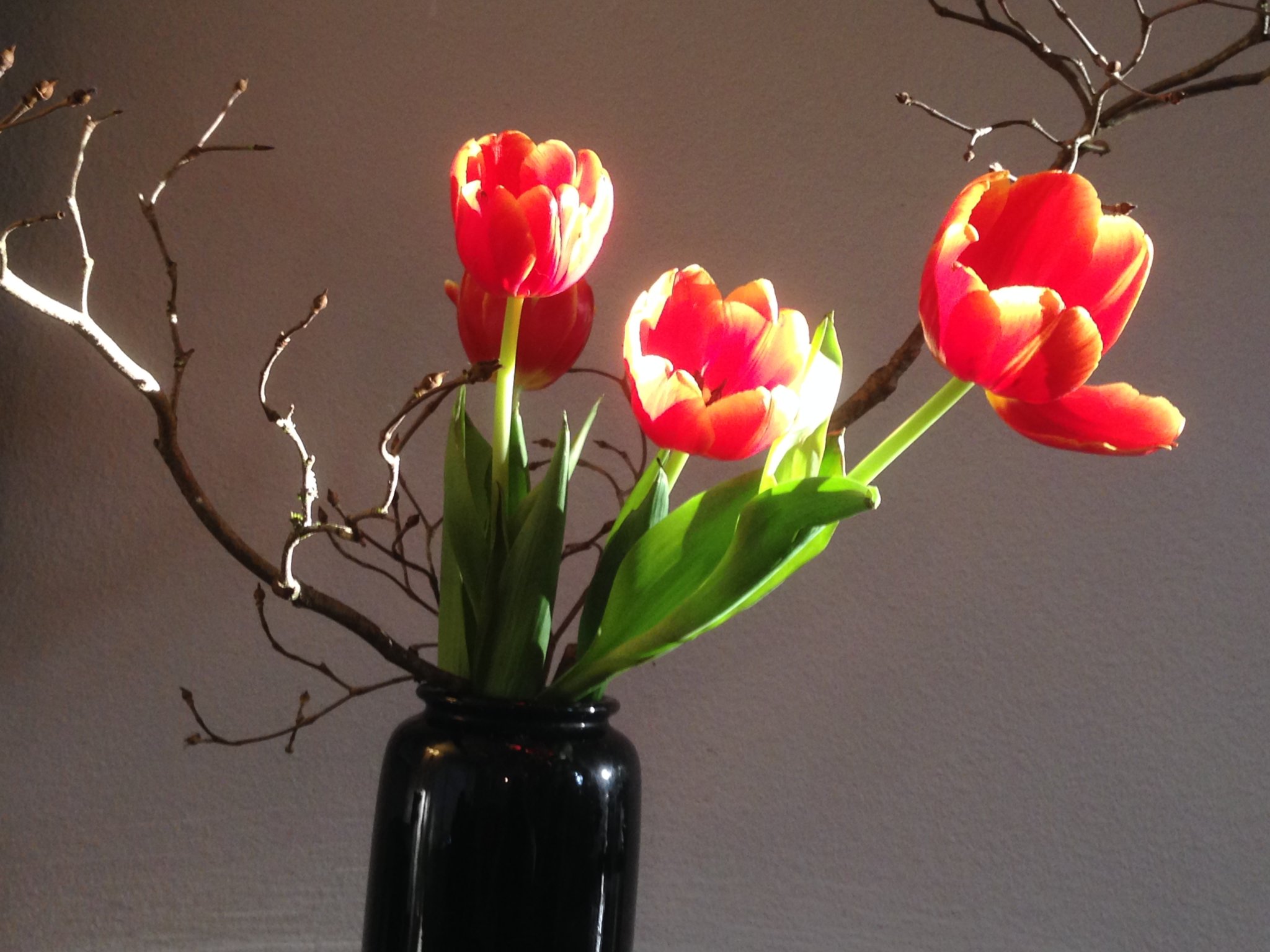
In that instant, you’re not just arranging flowers — you’re arranging your thoughts, your emotions, your energy. That’s the essence of Ikebana, the Japanese art of flower arrangement. More than decoration, it’s a moving meditation — a dialogue between you and nature, between what is seen and what is left unseen.
At first glance, Ikebana and Tai Chi might seem worlds apart. One works with flowers, the other with movement. But both share the same spirit: stillness in motion, awareness in simplicity, and peace through practice. In this blog post, we’ll explore how Ikebana teaches us to find calm through simplicity — and how its lessons extend far beyond the vase.
The Fascination of Details
The first time you try Ikebana, you might be surprised at how much detail goes into what seems like a simple arrangement.
The angle of a stem.
The height of a branch.
The space between two flowers.
You find yourself studying textures, shadows, and even the tiniest imperfections in a leaf. Every small adjustment changes the feeling of the piece — just like a slight shift in posture changes the feeling of a Tai Chi stance.
This deep fascination with details is not about perfectionism. It’s about awareness. In Ikebana, you’re training your eye to see — really see — what’s in front of you. The same skill we cultivate in Tai Chi, when we notice where our weight rests, how our breath moves, or how the energy flows through our fingertips.
When you slow down and observe the details, you start to notice harmony. You begin to feel the rhythm of life — not as a race to the next thing, but as a pattern unfolding in each moment.
This practice of detailed attention brings a kind of peace that only mindfulness can reveal.
Try this: next time you pour yourself tea, pay attention to the sound of the water, the steam rising, the way the light touches the cup. That small act of noticing can reset your nervous system. The same happens when we arrange flowers or move through a Tai Chi form — we find beauty in the details, and stillness within them.
The Power of Empty Spaces
If you’ve ever admired a Japanese garden or traditional painting, you’ve probably noticed something remarkable — the empty space feels alive.
In Ikebana, this principle is called “ma” — the space between. It’s the pause between notes in music, the silence that gives meaning to sound. It’s not absence, but presence.
When you first start arranging flowers, it’s tempting to fill the vase — to use all your branches, add more color, cover every angle. But as you practice, you begin to appreciate the beauty of what’s not there. You start removing instead of adding.
This is where Ikebana begins to teach one of its deepest lessons: empty space is not something to be avoided — it’s something to be embraced.
In Tai Chi, we experience this as the alternation between full and empty — yin and yang, movement and stillness, action and release. A stance becomes stable only when one side yields as the other engages.
When we breathe, the inhale and exhale must both exist — each defined by the space between.
Learning to trust the emptiness is an act of courage. It means letting go of control and finding peace in the unknown.
Next time you feel overwhelmed, take a breath and imagine space opening between your thoughts. Let stillness exist between your actions. That’s where creativity, clarity, and calm live.
Letting Go of Attachment
One of the most humbling aspects of Ikebana is impermanence. The flowers you so carefully arranged will fade. The leaves will wilt. The water will cloud.
And yet, that’s what makes it beautiful.
We live in a world that teaches us to hold on to possessions, routines, and even identities. Ikebana invites us to let go. It asks us to see the beauty of the moment for what it is — temporary, delicate, and therefore precious.
When you create an arrangement, you don’t cling to it. You let it exist, fully and gracefully, for as long as it does. Then you thank it and release it.
Tai Chi mirrors this same truth. Each movement flows into the next, never clinging, never frozen. The power of the form lies in its flow — and that flow depends on our willingness to release.
Letting go of attachment doesn’t mean indifference. It means love without possession. Presence without control. It’s an acceptance that beauty — like life — cannot be held, only experienced.
Try practicing this idea beyond Ikebana or Tai Chi. When a good moment happens — a beautiful sunset, a joyful laugh — enjoy it deeply, and then let it pass without grasping. The peace that follows is quiet but profound.
The Fearlessness to Cut
In Ikebana, the act of cutting is essential.
You prune branches.
You remove leaves.
You shorten stems that don’t serve the composition.
It takes courage to cut something living, to change what seems whole. But in doing so, you reveal form, balance, and expression.
Many people struggle with this step. They hesitate — not wanting to “ruin” the branch or “waste” the material. But the truth is, cutting is what makes creation possible.
The same is true in movement — and in life.
In Tai Chi, we “cut” through unnecessary tension. We refine our movements, trimming away effort and excess until only flow remains.
In our daily lives, we often need to prune, too — letting go of old habits, overcommitments, or beliefs that no longer serve us.
Cutting is not destruction. It’s refinement.
To cut is to trust that simplicity reveals truth. That by doing less, you make space for more meaning.
When you hold your shears next time — or make a difficult decision in life — remember this: a cut is not an ending. It’s an opening.
Finding Inner Calm Through Focus
When you practice Ikebana, something remarkable happens.
The noise fades.
Time slows down.
You enter a state of flow — completely absorbed in what you’re doing.
Your mind quiets not because you force it to, but because you’re present. You feel the stems in your hands, sense their resistance, and hear the soft sound of leaves brushing the vase. You’re here, now.
This is mindfulness in action.
Ikebana teaches calm not by demanding stillness, but by inviting attention. The focus on balance, line, and form creates a moving meditation where your breath, thoughts, and actions align naturally.
Tai Chi works the same way. When we move with awareness — when the mind follows the body and the body follows the mind — stress dissolves.
Both arts remind us that peace is not something you chase. It’s something you return to — every time you slow down enough to notice.
Big or Small — It’s All Expression
Ikebana can take many forms.
A towering installation that fills a room.
A single flower in a narrow vase.
Both are Ikebana — both complete in their own way.
In Tai Chi, we see the same truth. Whether practicing the long form or a single posture, every movement is whole. Every expression carries the same heart.
It’s not about scale; it’s about sincerity.
A single, mindful motion can hold more truth than an hour of rushed activity. A small arrangement, crafted with care, can hold more power than a grand display done for show.
When we understand this, we free ourselves from comparison — from the idea that more means better. We start to measure depth instead of width, quality instead of quantity.
So whether your “art” today is a flower, a meal, a conversation, or a Tai Chi form — do it with attention. Give it your heart. That’s all it takes to make it beautiful.
Embracing Impermanence
If Ikebana teaches one lesson above all, it’s impermanence.
Every flower fades. Every arrangement changes.
Even the water level in the vase tells a quiet story of time passing.
Instead of resisting this, Ikebana embraces it. The beauty lies not in preservation, but in participation — in being part of the moment as it unfolds.
Tai Chi carries this same wisdom. Each session is different. The body changes, the mind shifts, the energy flows in new ways. We don’t strive to repeat yesterday’s perfection; we move with what is true today.
When we accept impermanence, we find freedom. We stop fighting change and start flowing with it.
That acceptance transforms our relationship with life itself. We begin to see aging, loss, and transition not as enemies, but as natural expressions of movement.
Like the falling of a leaf or the bloom of a flower, each stage has its own grace — if we’re willing to see it.
The Connection Between Ikebana and Tai Chi
Ikebana and Tai Chi might speak different languages, but their essence is shared.
- Both are rooted in balance — between form and emptiness, movement and stillness.
- Both invite presence — the awareness that transforms action into art.
- Both honor nature — not just the external world, but the nature within us.
Practicing either is a path toward understanding the principles of life itself: simplicity, flow, impermanence, and peace.
When we integrate the lessons of Ikebana into movement — or movement into stillness — we cultivate harmony. We learn to move with grace in all we do.
Whether you practice Tai Chi, Ikebana, or simply seek a calmer, more intentional way of living, these principles can guide you toward balance and joy.
A Moment of Reflection
Before you close this page, take a deep breath.
Think of something in your life that feels cluttered — your schedule, your thoughts, your to-do list.
Now imagine arranging it like an Ikebana composition:
- Remove what doesn’t serve the balance.
- Create space for stillness.
- Let go of what no longer blooms.
- Focus on what brings life and harmony.
That’s Ikebana. That’s Tai Chi. That’s living in flow.
Finding the Heart
At the center of both Ikebana and Tai Chi lies a simple truth: peace is not something outside you — it’s something you cultivate within.
You don’t need a special space, a long practice, or even flowers. You need attention. You need breath. You need the willingness to pause, look, and feel.
When you practice this way — whether with flowers or movement — you begin to find what we call the heart in our book Finding the Heart. It’s that quiet, centered place inside where everything comes together.
Join Us
If these reflections speak to you, come join us in person.
At Bozeman Tai Chi, we explore these principles not just in words, but in motion — in community, in laughter, in shared practice.
Whether you’re curious about Tai Chi, Ikebana, or simply seeking a way to slow down and reconnect, our classes are open to all levels.
Reach out, visit us, or join a session.
You’ll be surprised how much peace you can find in the simplicity of a single movement — or a single flower.
“True beauty lies not in the flower, but in the space it opens within you.”
— Uli Staerk