
Don’t miss a post. Click here to sign up for our free newsletter.
If you have practiced the Form of 24 with us for a while, you have heard me say it. We arrive at the last Brush Knee and Push, the hands go out, and somewhere in the room my voice says, “Follow through… and regroup.” Then we settle back into Playing the Guitar, and the form flows on. It is one of those little cues that gets said so often it can start to sound like background music. Maybe you have wondered what it actually means. That is a very good question. Uli and I have been turning it over ourselves, and the longer we look at it, the more we find. So let’s take it apart together. There is a movement lesson hiding in those four words, and a life lesson standing right behind it.
Three Pushes That Are Not the Same
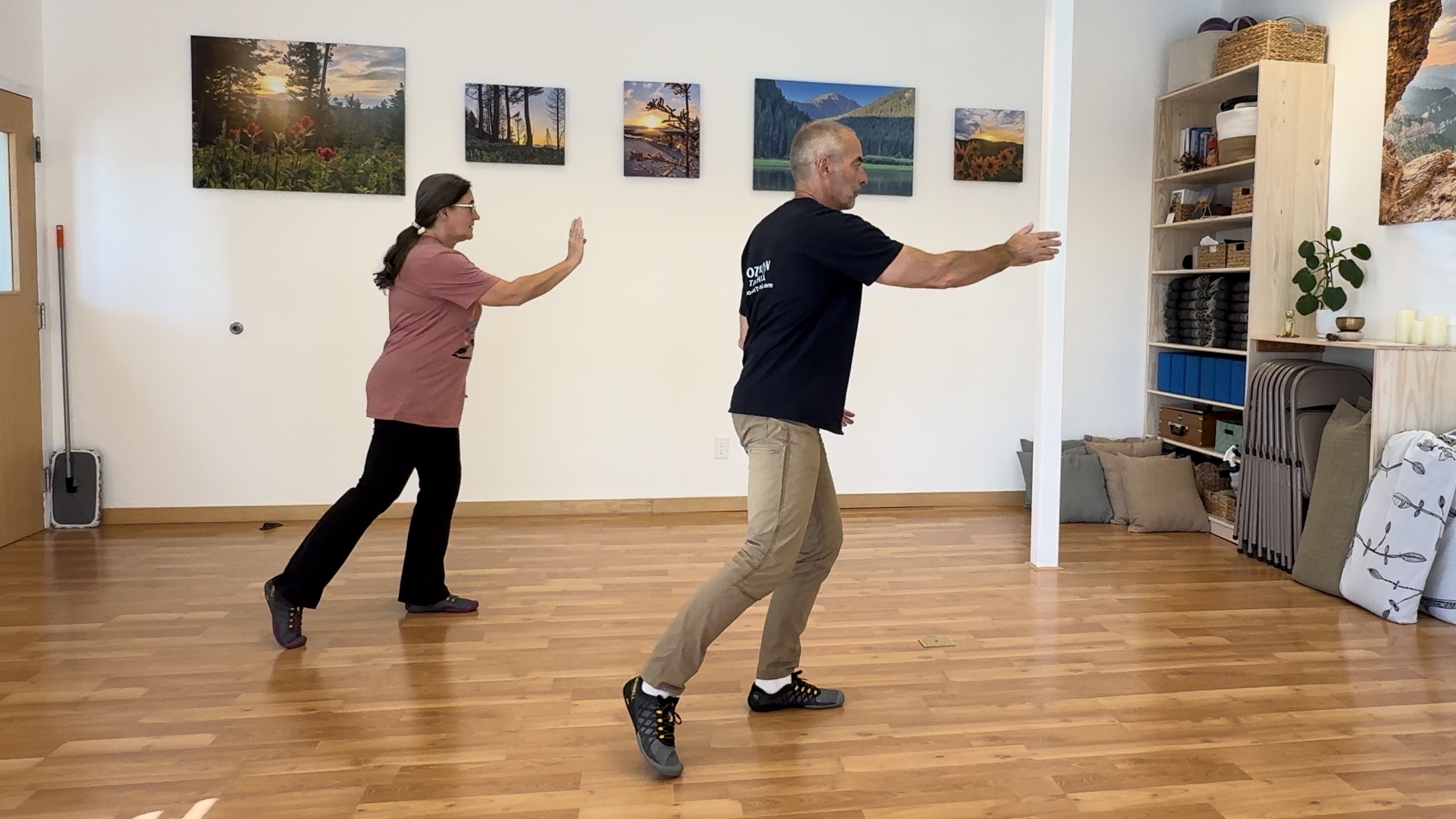
Picture the sequence. After Stroking the Horse’s Mane (in many books called Parting the Wild Horse’s Mane) and White Crane Spreads Its Wings, the 24 form moves into three Brush Knee and Push movements in a row: left, right, and left again. To the casual eye, they look identical. Same brush, same step, same push. You could easily think of the third one as simply a repeat of the first two. But ask yourself honestly: does the third one feel the same in your body? If you have been practicing for a while, it probably doesn’t. And it shouldn’t.
The first two Brush Knees are Tai Chi principles in their textbook form. They are balanced, measured, and safe. The push goes out with clear intention, but it never empties you. Your weight comes forward into the bow stance, yet your center stays comfortably inside your base. The front knee stays over the foot, the back leg is still alive and supporting, and the shoulders stay stacked over the hips. In the Yang expression of the push, there is still a visible amount of Yin left. Think of the familiar Taijitu, the Yin-Yang symbol: inside the large white swirl sits a small black dot. That dot is your reserve. Because it is there, the next movement comes easily. You sit back, turn, step, and brush again, and the waves of Yin and Yang keep rolling along without a bump.
The third Brush Knee is different. It is the end of the sequence, the last wave before the form changes its rhythm. Here we let the push go a little further. The arm extends a touch more. The center of gravity travels a bit more forward. For a brief moment we are closer to the edge of our base than before, and we feel, just for a breath, a little less settled. That is the follow-through.
And then, because we have reached further, we need to come back more deliberately. We rock back, sink into the back leg, gather the hands, and settle into Playing the Guitar. That return is bigger and more expressive than the small, easy transitions between the earlier pushes. It is not just a weight shift. It is a genuine regathering of the whole body before the next cycle of “normal” Yin-Yang transitions can begin. That is the regroup. Put simply, we over-express Yang for a moment, and so the Yin that follows needs to be expressed more strongly, too.
In class, the regroup is where we most often see people hurry. The push goes out beautifully, and then, almost before it has finished, the mind is already on its way to the next posture. The hands drift into Playing the Guitar, the weight hasn’t fully arrived in the back leg, and the body is still leaning slightly forward, still living in the push. It looks like a small thing, and it is. But small things add up in Tai Chi. A rushed regroup carries a little bit of imbalance into Repulse Monkey, and from there into everything that follows. A complete regroup, on the other hand, works like a reset button. The breath drops, the weight settles, the spine lengthens again, and the next section of the form begins from a clean, quiet place. How someone regroups tells us a great deal about how relaxed and rooted they really are.
The Little Step That Gives It Away
Here is something you can check for yourself the next time you practice, and it is one of my favorite details in the whole form. Watch your back foot after the third push.
During the first two Brush Knees, the back foot stays planted while you push, and then you sit back, turn, and step through into the next one. After the third, something new happens. The right foot comes forward a half step and lands behind you, and only then do you sit back into it, while the left foot lifts and touches down lightly on its heel for Playing the Guitar. This little half step is often called a follow step.
Why is it there? Because the body has traveled forward. The push has carried us further than before, and the back foot follows to catch up with the center and give us a fresh base under our weight. Then we sit into that new base. In other words, the form itself has written the follow-through and the regroup right into the footwork. It is not just a cue I like to say in class. It is built into the choreography, waiting for us to notice it.
The same pattern appears a few movements earlier, at the end of Stroking the Horse’s Mane. After the third Stroking the Horse’s Mane, the right foot comes forward a half step; we sit back onto it, then rise into White Crane Spreads Its Wings. Three movements, a fuller extension at the end, a follow step, a settling back, and then a new posture. Once you notice the rhythm in one place, you begin to feel it in the other.
Spotting the Exceptions
These over-extended moments are not the rule. Most of the form lives in that balanced, measured flow where the Yin never fully disappears from the Yang. But the bigger, more committed moments are a common exception, and they show up at various points in the forms. Watch for them, and you will spot them: places where the movement carries a little more reach and a little more intention, and is then followed by a clear gathering back in.
Noticing them matters, because it clears up one of the most common misunderstandings about Tai Chi, the idea that it is one long, mellow flow with the same lulling energy from beginning to end. It isn’t. In Finding the Heart, we wrote about celebrating the black and the white instead of coasting along in a perpetual gray, and this is a lovely place to practice exactly that. The forms hold moments of deep calm, and they hold moments with a little more excitement, a little more push and intentional follow-through. A form performed with one even, unchanging energy can look pleasant, but it misses the conversation between Yin and Yang that makes Tai Chi come alive. When you let the third push be the third push, and let the regroup be a real regroup, the whole sequence starts to breathe.
What the Classics Say, and Where We Explore
I want to be straightforward with you here, because we always want you to think critically about what you are taught, including what we teach.
The Tai Chi Classic traditionally attributed to Wang Zongyue asks us to avoid both excess and deficiency: no overdoing, no underdoing. A careful student might ask whether an over-extended push is exactly the kind of excess the classic warns against. It is a fair challenge, and Uli and I have asked it of ourselves more than once.
Here is where we have landed, at least for now. The excess the classic warns against is losing your structure: leaning forward, collapsing the posture, reaching with arms that have disconnected from the root, getting caught so overcommitted that there is no way home. What we mean by follow-through is something different. It is a fuller expression that stays connected. You remain upright. You stay rooted through the back leg until the follow step arrives. And above all, you always have the way back. A bigger reach with a built-in return is not the same as overreaching. In a sense, the follow step and the regroup are the “no excess.” They are what keeps the larger Yang from tipping over into a loss of balance.
There is an older idea that sits nicely beside this. In the eleventh century, the philosopher Zhou Dunyi wrote his short Explanation of the Diagram of the Supreme Ultimate, the Taijitu Shuo. He describes movement giving rise to Yang, and when movement reaches its limit, it turns toward stillness, and stillness gives rise to Yin. When stillness in turn reaches its limit, movement begins again. The larger the swing, the clearer the turning point. That is exactly what we feel at the end of the third push.
We don’t claim that every teacher reads the Form of 24 this way. Many will simply tell you that all three Brush Knees are the same posture, and in terms of the outer shape, they are. What we are sharing is something we have discovered in our own practice and continue to explore together with our students in class. It has made the sequence clearer and more alive for us. Try it, feel it, question it, and tell us what you find. That is how a living art keeps learning.
A Big Life Lesson in a Small Step
Now step off the practice floor for a moment. There is a Tai Chi lesson in the follow-through and the regroup, but there is also a big life lesson.
There are times when it is good to push harder, to overextend, to give it everything you have. A deadline that matters. A project you believe in. A hard training block before an event. A season of caring for someone you love. Those pushes are not a failure of balance. They are part of a full life, and sometimes they are the most meaningful parts of it. The trouble starts when we keep pushing and forget to regroup. We go from one big effort straight into the next, never rocking back, never letting the follow step catch up with us. Sooner or later, the body and mind remind us, usually at an inconvenient moment.
As a trainer, I see this all the time. Muscles don’t actually grow stronger during the workout itself; they adapt and rebuild during the recovery afterward. The effort sends the signal, and the rest builds the result. Skip the rest, and the push slowly turns into a leak instead of a gain. It is the same with our energy, our focus, and our good mood. A big effort deserves a real recovery, just like the third Brush Knee deserves a real Playing the Guitar.
Nature knows this rhythm well. Here in the Gallatin Valley, we have just come through the long, bright, busy days of summer and fall, and now November is settling in. The light shortens, the fields go quiet, and the land gets ready to rest under the snow. Nobody would call that laziness. It is the regrouping that makes next spring possible.
So go with the flow of Yin and Yang. Make the occasional push when it is appropriate, and make it wholeheartedly. Then come back to balance. Rest after the push. Recover after the effort. Not as a reward you have to earn, and not as a sign of weakness, but as the second half of the same movement.
Try This in Your Next Practice
Next time you practice the Form of 24 (or the Long Form, for that matter), slow down the Brush Knee sequence and pay attention to how each push feels. In the first two, notice the reserve. Feel the little bit of Yin that stays with you even at the fullest point of the push, and notice how easily it lets you sit back and flow into the next step.
On the third, let the push travel a little further. Keep your body upright and your back leg alive, and feel the moment when your weight wants the back foot to follow. Let it follow. Then sit back fully into that new base, gather the hands, and allow yourself one complete breath of genuine settling in Playing the Guitar before you move on into Repulse the Monkey. Afterward, try the same thing with the three Stroking the Horse’s Mane movements flowing into White Crane Spreads Its Wings, and compare.
A word of caution, too. The extra reach is small. If you feel you are about to tip forward, you have gone too far, and that is the excess the classics warn us about. This is especially important if balance is something you are working on. Keep the follow-through subtle and let the regroup be generous. The return matters more than the reach.
And when you finish, ask yourself one simple question: where in my week do I need to follow through, and where do I need to regroup?
Come Explore With Us
Details like these are hard to discover from a video or a book alone. They live in the body, and they often show up only when a teacher’s eye catches the moment where your push stops short, or reaches too far, or the regroup gets rushed. That is one of the joys of practicing together. We get to explore these questions side by side, and our students keep teaching us something new.
If this post made you curious, or if you see it differently, we would love to hear from you. Send us your questions, your observations, or your doubts. Comment on this blog post, reach out through BozemanTaiChi.com, come try a class, and let’s follow through and regroup together.
Keep practicing, push when it matters, and never forget to come back to center.