Don’t miss a post. Click here to sign up for our free newsletter.
“When in doubt, ward off!”
— Alfons
If you’ve spent any time in one of our Long Form classes, you’ve almost certainly heard those words. Sometimes it’s because someone momentarily forgets what comes next in the form. Sometimes it’s because we’re trying to lighten the mood after a particularly challenging section. Most of the time, it just makes everyone laugh. The phrase has become such a running joke around the studio that we eventually printed it on a T-shirt. And like many good jokes, this one contains a surprising amount of truth.
The Long Form returns again and again to Grasp the Sparrow’s Tail and its familiar Bird Sequence. New students often wonder why we spend so much time repeating the same handful of movements, especially once they realize the Yang style Long Form contains over a hundred postures in total. Shouldn’t we be moving on to something new instead of revisiting what we already know?
The answer only becomes clear after a few years of training. The Bird Sequence isn’t repeated because it’s easy. It’s repeated because it quietly contains nearly everything we’re trying to develop in Tai Chi. Every time we practice it, we refine our rooting, sharpen the coordination between our upper and lower body, learn to open and close the kua, relax our shoulders, soften our arms, and feel the continuous transformation between Yin and Yang play out in real time. We begin to understand how power can come from alignment rather than muscular effort, and how a movement becomes lighter the moment the whole body starts working as one. In many ways, the Bird Sequence is Tai Chi in miniature.
Once you start to understand its principles, you begin recognizing them everywhere else in the Long Form. The choreography changes, the stepping patterns vary, the hands travel through different pathways, but underneath all of that variety, the same handful of ideas keep quietly reappearing. The longer I practice, the more I’ve come to believe that the Long Form isn’t really teaching a hundred different techniques. It’s patiently teaching the same timeless principles from a hundred different angles, until they finally become natural. Every repetition peels back another layer that was invisible before. That’s why we keep coming back to Grasp the Sparrow’s Tail, and yes, when in doubt, Ward Off really is a pretty good place to begin.
One sequence, countless lessons
Traditionally, Grasp the Sparrow’s Tail introduces what are known as the Four Primary Energies, or jin, of Tai Chi: Ward Off (Peng), Roll Back (Lu), Press (Ji), and Push (An). These aren’t simply self-defense techniques. They’re different expressions of how connected movement gets generated throughout the whole body, and they trace all the way back to the Tai Chi Classics, the old treatises that generations of practitioners have studied and argued over ever since.
As we teach the sequence in class, we also spend a good bit of time exploring the yielding, drawing-in quality that naturally connects these energies to one another. This “pulling” quality isn’t traditionally counted among the Four Primary Energies, but it’s an essential skill for learning how to receive force before redirecting it. It helps students understand that Tai Chi isn’t about meeting force with force. It’s about transforming energy through timing, structure, and relaxation.
Once these ideas start to make sense, something interesting happens: the Long Form becomes much easier to understand. Instead of memorizing one movement after another, you start recognizing familiar conversations between the same fundamental principles. A posture may look completely different from the Bird Sequence on the surface, but underneath you’ll find the same expansion, the same yielding, the same focused intention, or the same broad issuing of energy. The movements turn into different words built from the same alphabet, and learning speeds up because you’re no longer collecting postures one by one. You’re learning a language.
Ward off: expanding without tension
The first of these energies is Ward Off, and its name sometimes creates the wrong picture in a beginner’s mind. Many students imagine pushing someone away or blocking an incoming strike with the arms. There’s a small grain of truth in that, but it barely scratches the surface of what Ward Off actually feels like.
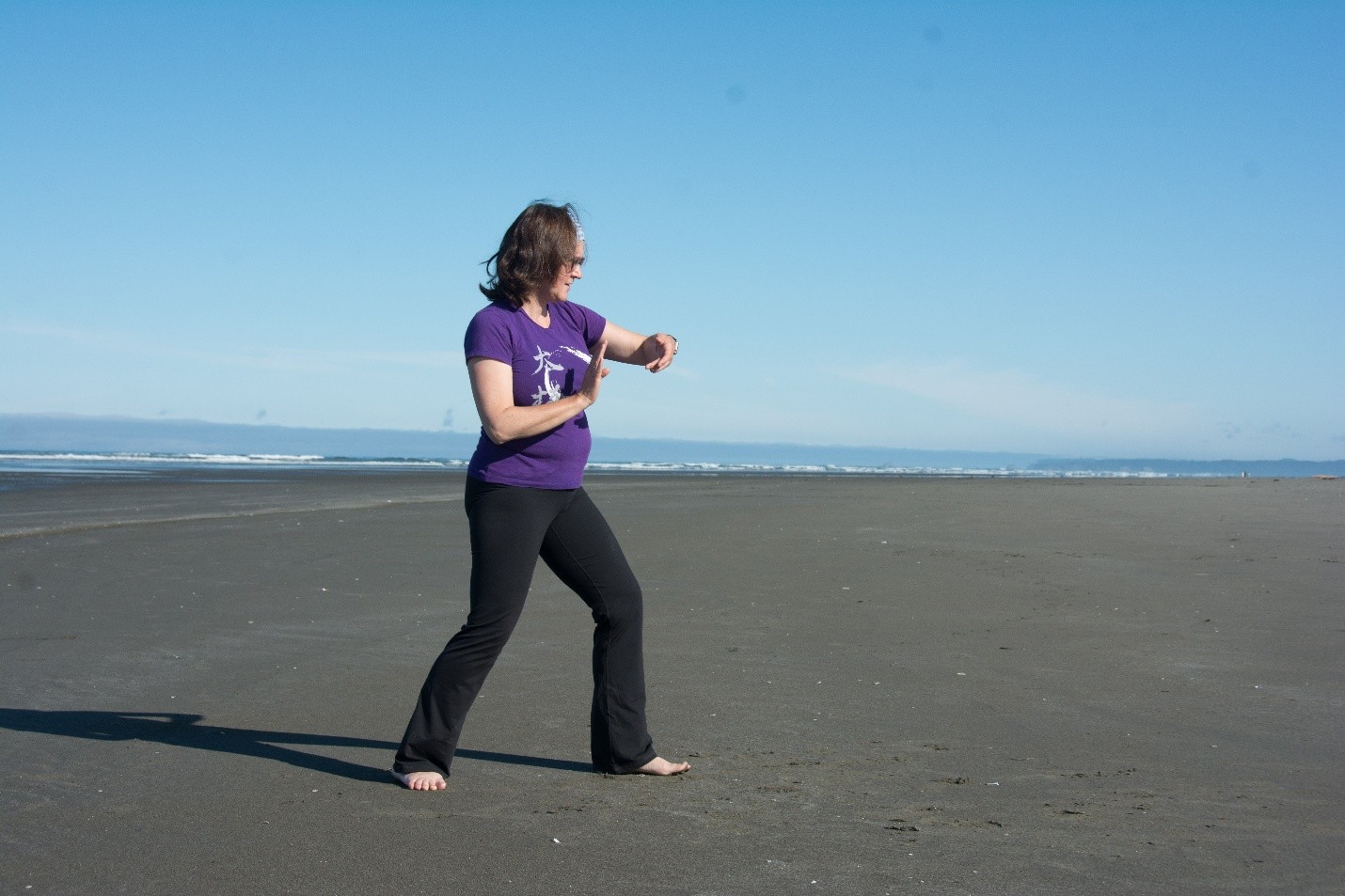
Ward Off is expansion. Imagine standing inside a large bubble that slowly inflates around your whole body, not just in front of you but evenly in every direction: upward through the crown of the head, downward through the feet into the floor, sideways through the elbows and fingertips, even gently widening across the back while the chest stays relaxed. Nothing is forced. Nothing becomes rigid. The body simply fills with connected structure.
One image we use often in class is a garden hose. An empty hose feels soft and floppy. Once water flows through it under pressure, the hose becomes supportive while staying flexible. It doesn’t turn brittle or stiff; it simply becomes substantial. Ward Off develops that same quality. Your arms aren’t held up by muscular effort; they feel gently filled from within. Your wrists stay relaxed, your fingers stay alive without stretching, your elbows hang naturally, and your shoulders settle downward. Everything feels supported by the connection to the floor rather than by tension in the upper body.
This is one of the great paradoxes of Tai Chi: the body becomes stronger as it becomes softer. Students often discover this for themselves during partner exercises. The harder they try to “be strong,” the easier they become to uproot. But when they relax, hold their alignment, and let the body expand naturally, they suddenly find themselves surprisingly stable. Strength stops coming from individual muscles and starts coming from connection, and that lesson reaches well beyond the practice hall. Many of us carry unnecessary tension in our shoulders, neck, and jaw through most of our day because we’ve mistaken tension for strength. Tai Chi gently offers another possibility: that relaxation and structure aren’t opposites at all, but depend on one another. Ward Off teaches us to occupy our own space with confidence without becoming hard about it. Expansive without being aggressive. Strong without being rigid. Present without being forceful.
Everything starts from the ground
One reason the Bird Sequence is so valuable is that it quietly teaches almost everything that should be happening below the waist. New students naturally watch their hands, since the hands are the most visible part of any movement, but experienced practitioners tend to pay far more attention to what’s happening in the feet, legs, and hips. That’s where the movement truly begins.
As we move through Ward Off, our weight shifts fully from one leg to the other. The supporting leg roots into the ground while the other leg stays light and free to step. The hips rotate smoothly without twisting the knees, and the kua, the crease where the legs meet the pelvis, opens and folds like a well-oiled hinge. When the kua moves freely, the rest of the body starts working as a single connected unit. When it doesn’t, the arms end up doing far too much of the work.
This is one of the most common habits we see in beginning students. They try to perform Tai Chi from the shoulders outward, so the hands stay busy while the hips remain almost frozen. The result can look correct on the surface, but the movement feels disconnected underneath. Over time, students realize the hands are simply expressing what the body has already created: the feet root, the legs support, the hips guide, the torso connects, and only then do the arms naturally follow. Once that relationship starts to click, almost every movement in the Long Form gets a little easier.
Roll back: redirect rather than resist
If Ward Off teaches us how to expand, Roll Back introduces a very different quality. Instead of meeting incoming force head-on, we learn to receive it, guide it, and let it continue in a direction that no longer threatens us. One of the best-known lines from the Tai Chi Classics, traditionally credited to Wang Zongyue, puts it this way: four ounces can deflect a thousand pounds. The line isn’t suggesting that a small person can magically overpower someone much larger. It’s reminding us that timing, direction, and structure often matter more than raw strength.
Imagine trying to stop a revolving door by pushing straight against it. You’d need tremendous effort. Now imagine placing your hand gently on the door and simply guiding its direction as it continues to turn. The amount of force required changes completely, and that’s how Roll Back works. Rather than colliding with incoming energy, we join it. We rotate through the waist, keep our rooted connection to the floor, and guide the movement along a curved path. The energy is neither passively absorbed nor aggressively rejected; it simply loses its effectiveness because it no longer travels where it intended to go.
This principle shows up everywhere in nature. A willow bends in a strong wind while rigid branches snap. A stream flows around rocks instead of smashing through them. Flexibility often succeeds where rigidity fails, though that doesn’t mean softness is always the answer. Tai Chi teaches balance: sometimes we expand, sometimes we yield, sometimes we redirect, and the real wisdom lies in recognizing which quality the moment calls for. As students grow more comfortable with Roll Back, they start noticing the same lesson showing up in everyday life. Not every disagreement needs immediate resistance. Not every challenge needs to be met head-on. Sometimes letting a situation unfold just a little before responding leads to a far better outcome. That isn’t avoidance; it’s intelligent timing, and like so many lessons in Tai Chi, it starts with a simple movement that keeps revealing more depth the longer you practice it.
Press: focused intention
After the broad, expansive quality of Ward Off and the circular redirection of Roll Back, the next energy takes us somewhere different again. Press gathers rather than spreads. Where Ward Off expands evenly in every direction, Press concentrates the body’s connected structure into a single point of intention.
A useful image here is the difference between sunlight and a magnifying glass. Sunlight spreads naturally across a wide area, while a magnifying glass gathers that same light into a much smaller point. The energy hasn’t changed; it’s simply become more focused, and that’s the feeling we’re after in Press. The movement never comes from pushing harder with the arms. Instead, the feet root, the legs support, the waist turns, and the connection travels through the torso and out through the hands, with every part of the body contributing a little until the whole thing works as one. Students often notice that when they try to create Press with the shoulders or arms alone, the movement feels heavy right away. When they let the whole body participate, the effort actually gets lighter while the result becomes far more effective.
That’s one of the recurring lessons of Tai Chi: efficiency almost always beats effort. The same idea holds up outside the practice hall. Whether we’re solving a tough problem at work, learning a new skill, or helping a friend through something difficult, scattering our attention rarely produces our best results. When mind and body work together toward a clear purpose, our actions become more effective with surprisingly little wasted energy.
Learning to yield
Between Press and Push sits one of the most valuable lessons in all of Tai Chi: yielding (Pull). In class we often describe this as the “pulling” quality within the movement. It’s not one of the classical Four Primary Energies, but it’s an essential skill for understanding how Tai Chi transforms incoming force instead of fighting it.
Yielding gets misunderstood often. Many people hear the word and think of giving up or surrendering, but Tai Chi teaches something quite different. Imagine someone trying to push open a door just as you begin pulling it toward yourself. Their force suddenly has nowhere to go, and the harder they push, the more they contribute to their own imbalance. The same principle runs through Tai Chi. Instead of resisting incoming pressure right away, we soften just enough to receive it. We stay rooted, keep our structure, and let the incoming energy reveal its direction before we choose how to respond.
That takes a certain kind of confidence. Reacting immediately often feels easier because it satisfies our instinct to defend ourselves, but yielding asks us to stay calm just a little longer, to trust our balance instead of our strength. For many students, this becomes one of the great gifts of practicing Tai Chi, and the lesson gradually extends well beyond partner exercises. Life has a way of throwing unexpected challenges our way: a difficult conversation, a stressful day, a disappointing phone call, a family disagreement. Our first instinct is often to push back right away. Tai Chi quietly offers another possibility. Can we receive what’s happening without immediately tensing up? Can we let the initial emotional energy settle before deciding how to respond? Can we stay rooted while everything around us feels unsettled? Yielding doesn’t mean accepting poor treatment or avoiding hard conversations. It means refusing to let someone else’s momentum decide our response, and there’s real strength in that.
Push: taking the initiative
Eventually, every conversation reaches a point where it’s time to move forward, and that’s where Push enters. Students sometimes confuse Press and Push since both send energy forward, but the difference lies in how that energy is expressed. Press feels concentrated. Push feels expansive. Imagine placing both hands against a stalled car. You’re not trying to poke a single point; your whole body connects through a broad surface as you steadily move the car forward. That comes much closer to the feeling of Push.
Once incoming energy has been neutralized through yielding and redirection, there’s no longer any need to struggle against it. The path is clear, and the body can move forward with relaxed confidence and unified structure. As with every other energy, Push begins in the feet. The legs drive, the waist coordinates, the torso connects, and the arms simply transmit what the rest of the body has already created. Students are often surprised by how little arm strength is actually required once the whole body works together, and the movement becomes smoother, more connected, and far less tiring as a result. This is one of the reasons Tai Chi practitioners can keep practicing well into their seventies, eighties, and beyond. Rather than relying mainly on muscular strength, we continually refine coordination, timing, balance, and efficient movement, qualities that don’t fade nearly as quickly with age and, if anything, tend to keep improving.
A conversation between Yin and Yang
When we first start learning Tai Chi, Yin and Yang often feel like abstract philosophical ideas. Eventually they become something we can actually feel. Ward Off teaches us expansive Yang. Press teaches us focused Yang. Push teaches us directed Yang. Roll Back teaches us receptive Yin. Yielding develops Yin by receiving, listening, and allowing rather than forcing. Neither quality is better than the other, since without Yang nothing happens, and without Yin nothing can adapt.
The beauty of the Bird Sequence is that it lets us experience these transformations again and again in just a handful of movements. Expansion naturally becomes yielding. Yielding becomes concentration. Concentration becomes expression. Then the cycle begins once more. The sequence never feels static, because life itself is never static, and Tai Chi simply teaches us how to move with those changes instead of resisting them. That may be one of the reasons this practice still feels so relevant today. Modern life pushes us to move faster, react quicker, and fill every moment with activity, while Tai Chi invites us to slow down just enough to notice what’s actually happening. Ironically, that slower pace often leads to better decisions and more efficient movement in the end.
Why we keep coming back
Students occasionally ask when they’ll finally “master” Grasp the Sparrow’s Tail, and I usually just smile. After more than three decades of studying and teaching Tai Chi, I still find new details every time I practice it. Some days I notice my rooting more clearly. Other days I become aware of how much freer my hips can move. Sometimes I realize I’ve been carrying unnecessary tension in my shoulders without noticing it, and on another day I might suddenly understand a transition I’ve performed thousands of times before. The sequence hasn’t changed. I have. That’s one of the great joys of Tai Chi: the movements stay remarkably consistent while we keep growing into them, and each repetition becomes less about memorizing choreography and more about discovering ourselves.
In many ways, Grasp the Sparrow’s Tail becomes a small laboratory where we can safely experiment with the principles that eventually show up throughout the entire Long Form. We learn how to root before moving. We discover how opening creates closing. We feel how the Kua initiates movement while the hands simply follow. We experience how relaxation creates structure instead of weakening it. We explore expansion, yielding, concentration, and expression until they gradually stop feeling like separate ideas and start working together naturally. Eventually those qualities show up not only in our Tai Chi, but in how we walk, stand, breathe, climb stairs, carry groceries, and respond to whatever the day throws at us. That’s when Tai Chi quietly starts leaving the practice hall and becomes part of daily life.
So, when in doubt?
That brings us back to our favorite classroom joke: when in doubt, ward off. We still laugh every time someone says it, but maybe the joke has stuck around this long because everyone recognizes the deeper truth behind it. Whenever our movements feel disconnected, Ward Off reminds us to reconnect with the ground. Whenever our shoulders get tense, it reminds us to soften. Whenever our hands start taking over, it reminds us that movement begins in the feet and hips. Whenever we lose sight of the bigger principles, Grasp the Sparrow’s Tail brings us right back to the foundations that support the entire art. The sequence isn’t just another section of the Long Form; it’s one of the clearest windows into what Tai Chi really is, which is why we practice it so often, why teachers have emphasized it for generations, and why, after all these years, I still look forward to it every single day.
So the next time you hear us say “when in doubt, ward off,” know that we’re only half joking. Behind those four simple words sits a lifetime of practice, discovery, and refinement. If you’re curious to feel these ideas for yourself, we’d love to welcome you into one of our classes. Whether you’re taking your first steps into Tai Chi or you’ve been practicing for years, there’s always another layer waiting to be found. We explore these principles together in a relaxed, supportive environment where questions are welcome, laughter is common, and progress comes one mindful step at a time. Reach out any time to join us, and perhaps you’ll even find yourself smiling the first time someone forgets the next movement, pauses for a moment, and confidently chooses Ward Off. After all, it’s not a bad place to begin.