Don’t miss a post. Click here to sign up for our free newsletter.
There’s a moment in every Tai Chi movement that almost nobody notices, and yet it’s the moment that decides whether the rest of the movement will feel powerful and controlled, or wobbly and rushed. It happens right at the transition, the instant your weight begins to shift from one leg to the other, just before your arms start doing the ‘interesting’, visible part of the form. Most students, especially in the first year or two, blow right past this moment without ever knowing it existed. I certainly did. It took me years of correction and a fair amount of patient repetition before it finally sank in.
The principle itself is simple to say and surprisingly hard to live by: anchor first, then move. Plant your foot, let it fully arrive, and only then let your arms begin their journey. It sounds almost too basic to deserve its own blog post. But if you watch a room full of Tai Chi students, beginners and long-time practitioners alike, you’ll see this principle broken constantly, usually without anyone realizing it’s happening.
What “Anchor First” Means
Let’s get concrete about what we mean by an anchor. In a forward movement, like stepping into a bow stance, your anchor point is your heel touching down. In a backward movement, like settling into an empty stance, your anchor is the ball of your foot and your toes, making contact with the ground. Either way, there is a specific, identifiable moment where your foot commits to the earth. That moment is your anchor.
The rule is that your arms shouldn’t begin their real work until that anchor has landed. Not before. Not “at the same time, more or less.” After.
I know this sounds pedantic, and maybe even like it goes against everything we say about Tai Chi being one continuous, unbroken flow (and it is; we’ll get back to that). But bear with me, because the sequencing here isn’t about creating a stop in your movement. It’s about respecting the order in which power actually needs to travel through your body.
The Chain: Feet, Hips, Spine, Hands
This is one of those principles that shows up again and again across the old Tai Chi writings, going back centuries, long before anyone thought to write a blog about it. The general idea, passed down through generations of teachers, is that your root lives in your feet, your power is generated through your legs, it’s directed and organized by your hips and waist, carried upward through your spine, and only at the very end does it show up, expressed in your hands. It’s a chain, not a broadcast. Each link has to do its job in order, or the whole thing falls apart.
Think about what that means for your practice. Your feet are the foundation, the part of you in contact with the ground, the part that either gives you a stable base or doesn’t. Your hips are what take that foundation and decide which direction the energy should travel. Your spine is the highway that carries it upward, and your hands are simply where all of that arrives, the visible tip of an invisible iceberg. If you skip a step in this chain, if your hands start moving before your feet have finished their job, you haven’t shortened the process. You’ve broken it.
This is why, in class, we spend so much time talking about the boring, unglamorous foundational stuff: your feet, your rooting, your weight shifting. Nobody joins a Tai Chi class dreaming about their heels. Everybody wants to get to the flowing arm movements, the spirals, the sense of energy moving through their hands. But you can’t build a house by starting with the roof, and you can’t build a Tai Chi movement by starting with the hands.
Moving Too Early Makes You Flail
Here’s where the anchor principle gets practical, and where I think it explains something that frustrates a lot of students without them quite knowing why. If you let your arms start moving before your foot has anchored, before your heel has landed in a forward step or your toes have settled in a backward one, you end up trying to balance and generate movement at the same time, using the same unstable base. Your body senses this instability, even if your conscious mind doesn’t quite register it, and it compensates the only way it knows how: by tensing up, by making small corrective jerks, by essentially flailing rather than flowing.
I don’t mean flailing in a dramatic sense, arms waving everywhere. I mean the small, subtle version of it: the slight wobble in a turn, the arms that seem to move independently of the body rather than as an expression of it, the movement that looks technically correct but somehow doesn’t feel grounded or controlled when you’re doing it, and doesn’t look grounded when someone else is watching. If you’ve ever felt like your form is “fine” but not quite settled, not quite yours yet, there’s a good chance the anchor sequencing is part of what’s missing.
And there’s a second cost here that’s just as important as the wobble: control. When your anchor lands first, and your movement builds from there, you can stop, adjust, or change your mind mid-movement if you need to. You are, in a very real sense, driving the car. When you move your arms before your foot has committed, you’re not driving anymore; you’re being carried along by momentum you didn’t fully create on purpose, and stopping or redirecting becomes much harder. In self-defense terms, and remember that every one of these movements has roots in a martial application even if health is why most of us practice today, an uncontrolled movement is a vulnerable one. You can be redirected, unbalanced, or simply outmaneuvered if your own structure isn’t stable enough to change course.
Feel It For Yourself
The good news is that this principle is not abstract. You can feel it directly in two of our most basic stances, and I’d encourage you to spend some quiet time with both of them, slowly, almost absurdly slowly, until the sequencing becomes obvious in your body rather than just an idea in your head.
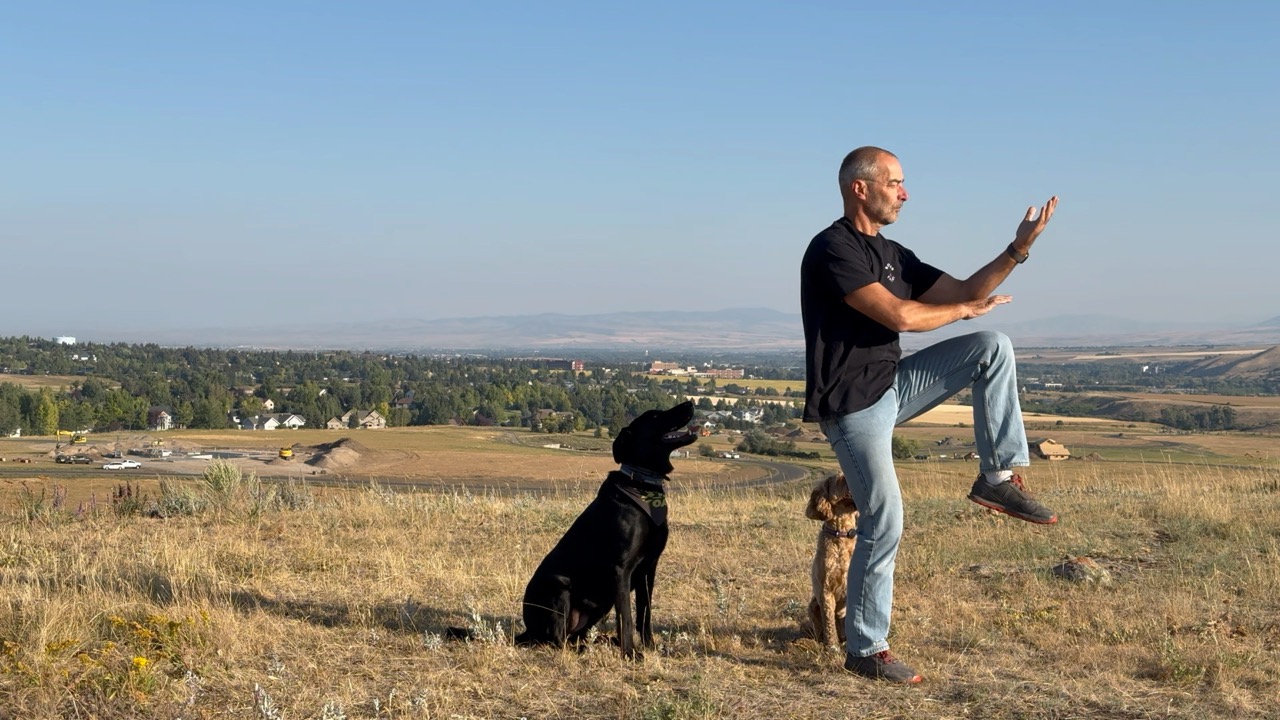
Start with the forward bow step. As you shift your weight and step forward, notice the exact instant your heel touches down. Now here’s the exercise: hold everything else still for a breath. Let your heel fully arrive, feel your weight begin to settle into it, and only then allow your hip to turn and your arms to begin extending forward. You’ll probably find that this feels unnaturally slow the first several times you try it. That’s fine. Slow is exactly the point right now. Over time, the gap between anchor and movement shrinks until it becomes seamless, but the sequence itself, foot first, then hip, then spine, then hands, never goes away. It just gets fast enough that nobody watching can see the individual links anymore, even though they’re still there.
Now try the backward empty stance, which is really the same lesson taught from the other direction. As you shift your weight back, notice the moment your toes (or the ball of your foot, depending on the exact stance) settle into the ground behind you. Again, let that landing fully happen before you let your hands retreat or your body respond. This is a stance we return to constantly through the form, and it’s worth treating as its own small practice, not just a transition you rush through to get somewhere more interesting.
The Real Payoff: Your Turns
If there’s one place where this principle stops being a nice theoretical idea and becomes something you absolutely cannot fake your way through, it’s in our turns, especially the bigger ones. A controlled 180- or 270-degree turn depends entirely on this sequencing. Your anchoring foot must fully commit to the ground before your body begins to rotate around it. If you try to initiate the turn with your upper body or your arms before your foot has found its anchor and taken your weight, you’ll spin yourself off balance almost every time. I’ve watched this happen to students (and to myself, plenty of times over the years) more often in the bigger turns than almost anywhere else in the form, precisely because a bigger rotation asks for more commitment from your anchor, not less.
Think about it almost like a pivot point on a hinge. A hinge only works because one side of it is fixed. If both sides are trying to move independently, you don’t get a smooth rotation; you get chaos. Your anchoring foot is that fixed side of the hinge for the moment of the turn. Everything else — your hips, your spine, your arms — gets to rotate freely and gracefully precisely because that one point is committed to being still and grounded first.
This is also, by the way, a wonderful example of how Yin and Yang show up in something as concrete as a turn. The anchor is Yin: still, receptive, grounded, patient. The rotation that follows is Yang: active, expressive, expansive. You need both, and you need them in the right order, or the movement never quite comes together into something whole.
This Isn’t About Stopping
I want to circle back to something I mentioned earlier, because I don’t want anyone reading this to think we’re suddenly contradicting everything we’ve said about Tai Chi being a continuous, unbroken flow, like a wave that never stops moving. We are not asking you to insert a pause into your form. The anchor doesn’t create a stop; it creates a sequence, and a fast, well-practiced sequence looks and feels completely fluid to an outside observer.
Think of a wave again. A wave doesn’t stop as it moves through water, but there is still an order to what happens: the water beneath moves before the crest breaks forward. If the crest happened before the underlying water had moved, it wouldn’t be a wave anymore; it would just be a wall of water falling over. The order matters even inside something that never technically pauses.
The same is true here. As you get more comfortable with the anchor principle, the time between your foot landing and your arms responding shrinks down to something almost imperceptible. But it never disappears entirely, because that small gap, that brief moment of commitment, is exactly what gives the following movement its power, its stability, and its ability to be redirected or stopped on a dime if needed.
A Simple Thing to Try This Week
If you want a small, doable homework assignment from this post, here it is: pick just one movement from your form, ideally one that involves a step forward into a bow stance or a settle back into an empty stance, and practice it in dramatically slow motion for a few minutes. Exaggerate the pause between your foot landing and your hands beginning to move. Make it almost cartoonishly slow if you have to. Then gradually speed it back up to normal tempo, trying to preserve that same sense of “foot first, then everything else” the whole time. You may be surprised at how different the movement feels, how much more grounded and intentional it becomes, once that sequencing is deliberate rather than accidental.
This is also exactly the kind of detail that’s much easier to feel with a teacher’s eyes on you than to figure out alone at home from a video or a blog post (even this one). Watching for these small sequencing errors and gently correcting them is a huge part of what happens in our classes week to week. If you’ve been practicing on your own and sense that something isn’t quite settling the way you’d like, especially in your turns, this might be exactly the missing piece.
We’d love to have you join us in class here at Bozeman Tai Chi and work through this together. Whether you’re brand new to Tai Chi or you’ve been practicing for years and are looking to refine the details, there’s always another layer to discover, and the anchor principle is one of those quiet, foundational lessons that keeps paying off no matter how long you’ve been at this. Reach out through our website, come try a class, and let’s find that stillness inside the movement together.
Keep practicing, stay rooted, and enjoy the ride!