
Don’t miss a post. Click here to sign up for our free newsletter.
Strong, Smooth, Alive: The Calm Power of Tai Chi
There is a particular kind of strength that doesn’t announce itself. It doesn’t look tense or dramatic. It doesn’t rush. Yet when you encounter it—whether in a person, a movement, or even a moment—it’s unmistakable. Calm. Stable. Effortless. Present.
This is the kind of strength Tai Chi cultivates.
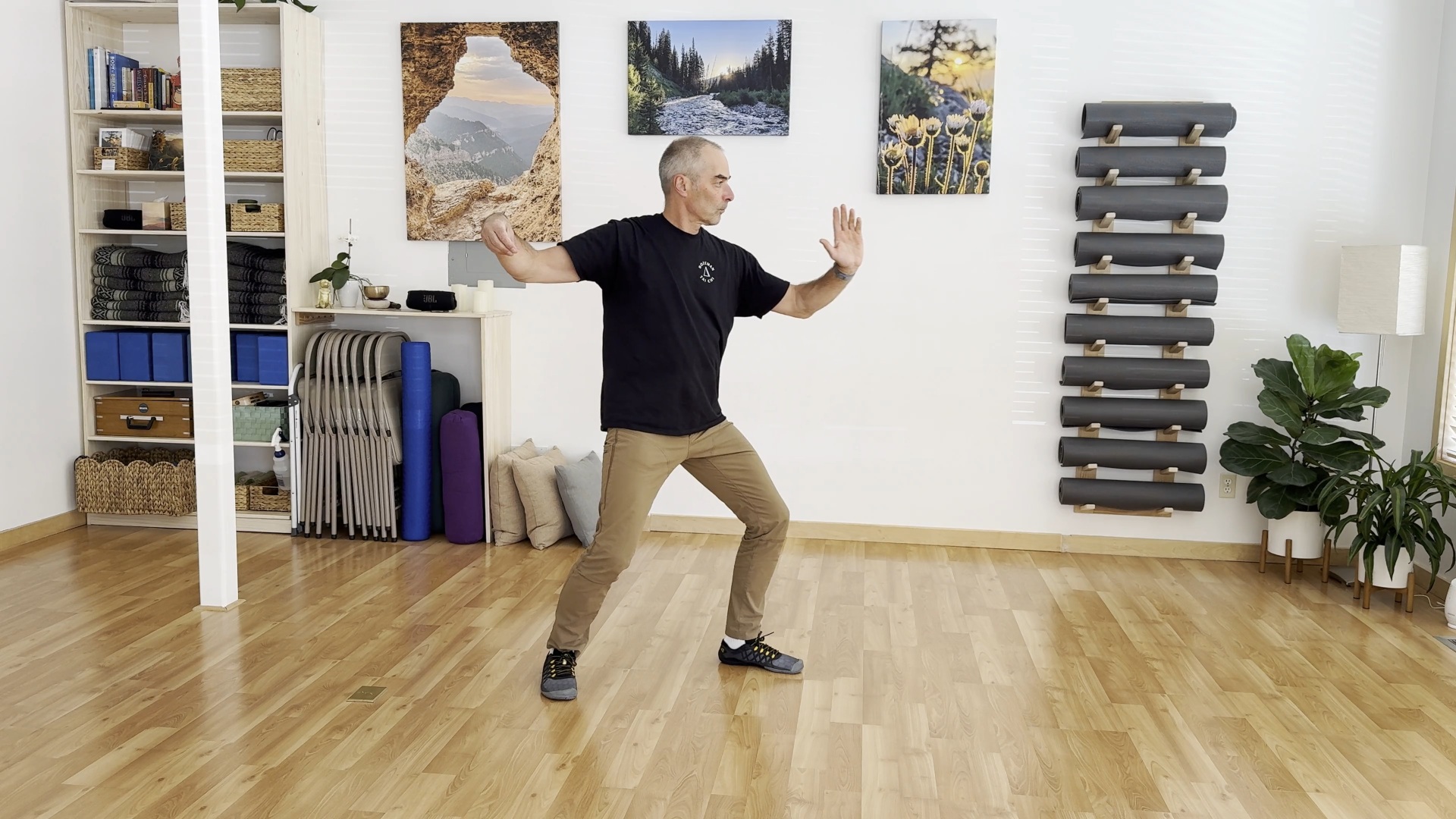
When people first see Tai Chi, they often comment on how slow and gentle it looks. And that’s true—on the surface. But what’s easy to miss is the depth of organization underneath that softness. Tai Chi is not about moving less. It’s about moving better. More efficiently. More intelligently. With every part of the body contributing at the right time, in the right way.
Today, I want to share some of the core movement principles behind strong, graceful, and smooth flow. These are principles we practice in every class, even when they aren’t explicitly named. They are simple, but not simplistic. And once you start to feel them, they change not only how you move in Tai Chi, but how you move through life.
The First Shift: Dropping Instead of Reaching
Most of us are used to reaching upward when we move. We lift our chest, tighten our shoulders, raise our arms, and try to “do” movement from the top down. Our attention lives in our head, and our effort follows it.
Tai Chi gently invites a different approach. Instead of lifting, we begin by dropping.
We drop our attention downward, out of the busy thinking mind and into the body. Into the breath. Into the feet. Into the contact with the ground. This simple shift already changes everything. Balance improves. Breathing softens. The body feels more present and less fragmented.
Along with attention, we drop unnecessary activation. That background tension many of us carry—especially in the shoulders, neck, jaw, and hands—starts to quiet down. Not because we force it to relax, but because it’s no longer needed.
This is often a surprising experience for students. They expect that to move with strength, they need to activate more. Instead, they discover that much of their effort was compensatory. When attention drops, and the body organizes itself more clearly, movement becomes both lighter and stronger at the same time.
This is where real power begins—not in effort, but in clarity.
Power as a Conversation With the Ground
In Tai Chi, power does not originate in the arms. It doesn’t start in the shoulders or the hands. Those are simply the places where power becomes visible.
True power starts much lower. It begins with how you meet the ground.
When your feet are relaxed, evenly weighted, and awake, they form a living connection with the earth beneath you. This connection is not rigid or forceful. It’s responsive. Subtle shifts in pressure and balance travel upward through the body, informing every movement.
From the feet, force travels through the legs, guided by the knees, gathered by the hips, transmitted through the spine, and only then expressed through the arms and hands. Each part of the body participates, passing energy along like a relay rather than trying to do everything itself.
This idea—that movement is a continuous chain rather than a series of isolated actions—is central to Tai Chi. When one link in the chain tries to dominate, the whole system suffers. When each link does its part and trusts the others, movement feels unified and whole.
Rooting plays a key role here. To be rooted does not mean to be stuck or heavy. It means that even as you move, turn, or shift, you maintain a stable relationship with the ground. Like a tree swaying in the wind, your upper body remains free precisely because your base is secure.
Once this rooting is established, activation naturally rises upward. You don’t have to force it. The body knows what to do when it’s allowed to work as an integrated system.
Why Strength Begins Slowly
One of the most overlooked aspects of graceful power is timing.
Not all muscles are meant to fire at the same time or in the same way. Some muscles are designed for endurance and stability. Others are built for speed and precision. Tai Chi honors this natural division of labor.
Large, strong muscle groups—like the thighs, glutes, and deep core—are slow to activate, but capable of sustaining force. These muscles form the foundation of movement. When they engage first, they create stability, direction, and mass.
Smaller muscles—such as those in the arms and forearms—are quicker and more responsive. They are excellent at fine control, but they fatigue easily when overused. In Tai Chi, these faster muscles are invited to join the movement later, once the foundation is already in place.
When this sequencing is respected, something remarkable happens. The entire body arrives at the end of a movement together. Nothing rushes ahead. Nothing lags behind. The result feels coordinated, powerful, and surprisingly effortless.
I often compare this to a rocket launch. The strongest boosters fire first, providing the initial lift. Faster stages engage later, refining and directing the motion. Each phase has its role, and timing is everything.
Practicing Tai Chi slowly allows us to feel this sequencing clearly. Slowness reveals habits we didn’t know we had—especially the tendency to let the arms lead or to tense prematurely. Over time, the body relearns a more intelligent order of operations, and power becomes smooth instead of abrupt.
Letting Go Without Collapsing
Perhaps the most challenging—and most rewarding—principle in Tai Chi is learning to release tension without losing structure.
Many of us equate relaxation with collapse. We worry that if we let go, we’ll become weak or unstable. Tai Chi shows us another option: relaxed strength.
The key lies in alignment.
When the bones are stacked efficiently, and the spine is upright, muscles don’t need to hold us together. They are free to respond rather than brace. The body becomes stable not because it’s rigid, but because it’s well organized.
An upright spine is central to this process. Not stiff. Not exaggerated. Just naturally elongated, as if the head were gently floating upward. From this position, everything else can soften. The shoulders drop. The chest relaxes. The breath deepens.
I sometimes invite students to imagine tension falling away like water droplets sliding off a leaf. No effort. No struggle. Just release. The jaw softens. The neck lengthens. The arms feel heavy and supported rather than held up by effort.
What remains is a kind of strength that feels calm and grounded. It’s available when needed, but it doesn’t announce itself unnecessarily. This is the strength that endures.
When Flow Emerges
Flow is not something you force or perform. It arises naturally when conditions are right.
When attention is grounded, when movement is initiated from the base, when muscles engage in the right order, and when tension is allowed to dissolve, movement becomes continuous. One action leads seamlessly into the next. The body feels unified rather than fragmented.
This experience of flow is deeply satisfying. It’s not just about aesthetics, though Tai Chi can certainly look beautiful. It’s about how movement feels from the inside. Calm. Connected. Alive.
Over time, this quality begins to show up beyond the practice space. Walking feels lighter. Standing feels easier. Every day tasks require less effort. Even the mind benefits, as the nervous system learns that strength does not require constant tension.
Why Practicing Together Matters
These principles can be described in words, but they are learned through experience. Small adjustments make big differences, and it’s often difficult to see our own habits without feedback.
This is why practicing in class matters.
In class, we slow things down together. We explore these ideas in a supportive environment. We learn not by pushing, but by listening—to our bodies and to each other. Over time, subtle changes accumulate, and movement begins to reorganize itself from the inside out.
Whether you are new to Tai Chi or returning to deepen your practice, there is always another layer to discover. The art is endlessly rich, and the body is an honest teacher.
If you’re curious about cultivating strength that feels calm, grounded, and sustainable—if you want to move with more ease and confidence—I invite you to reach out and join a class. Come experience what strong, graceful, and smooth movement truly feels like.